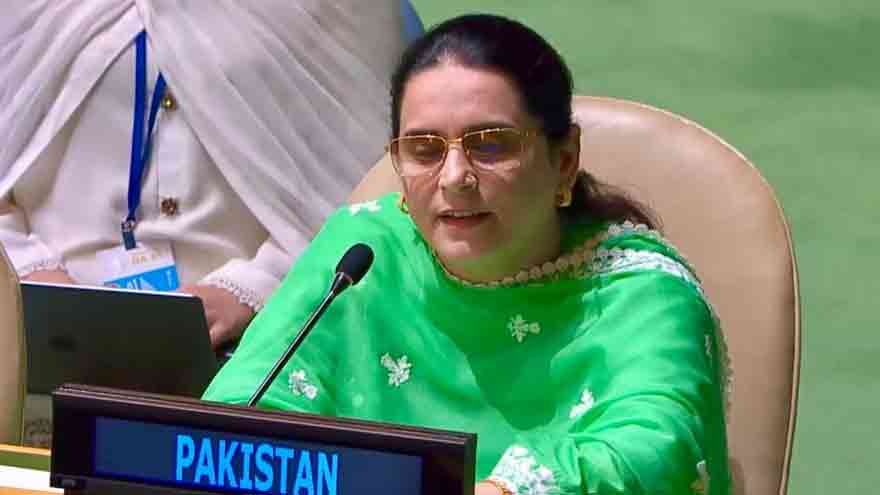
In a sharp diplomatic exchange at the United Nations, Pakistan has accused India of “exporting terrorism and violence while trying to import victimhood and sympathy,” delivering a forceful right of reply during the General Debate of the 81st session of the UN General Assembly in New York.
Pakistan’s Right of Reply at the UN
Counsellor Saima Saleem, delivering Pakistan’s response to remarks by the Indian representative, accused New Delhi of relying on propaganda and disinformation in its diplomatic approach. Her statement raised concerns spanning terrorism, the disputed region of Jammu and Kashmir, minority rights, and the Indus Waters Treaty.
“Pakistan knows the cost of Indian-sponsored terrorism all too well,” Saleem said, claiming that Pakistan has lost nearly 100,000 lives to terrorism since the turn of the century, in addition to significant economic losses.
Allegations of State-Sponsored Terrorism
Saleem said Pakistan had presented what it described as evidence of India’s financing, aiding and abetting of terrorist groups targeting Pakistan, including the TTP, BLA and Majeed Brigade. She further accused India of failing to unequivocally condemn attacks targeting Pakistani civilians.
The Pakistani representative also referenced cases involving Indian national Kulbhushan Jadhav and Nikhil Gupta, citing them as part of Islamabad’s allegations concerning India’s involvement in terrorism and overseas operations.
Jammu and Kashmir Dispute
On Jammu and Kashmir, Saleem reiterated Islamabad’s position that the territory remains an internationally recognized disputed territory. She accused India of maintaining an “illegal occupation” and denying Kashmiris their fundamental rights, including the right to self-determination.
Concerns Over Minority Rights in India
Saleem criticized India’s domestic policies toward minorities, alleging that the ruling RSS-BJP dispensation had institutionalized Hindutva ideology in state policy and practice. She raised allegations concerning discrimination and violence against Muslims, Christians, Dalits and Sikhs.
Indus Waters Treaty and Water Security
Addressing water issues, the Pakistani representative criticized India’s decision to hold the Indus Waters Treaty in abeyance, describing water as a lifeline for Pakistan’s population.
Reference to May 2025 Conflict
Saleem also referred to the May 2025 conflict between Pakistan and India, saying India had suffered a “crushing defeat” during what she called Marka-e-Haq, arguing that the episode had affected India’s credibility.
Pakistan’s Commitment to Peace
Concluding her statement, Saleem said Pakistan remained committed to peace, mutual respect, dialogue and the peaceful settlement of disputes.
“We will defend ourselves whenever aggression is imposed upon us, but we will never abandon the path to peace,” she said, adding that lasting strength lies in the peace a nation has the courage to build and defend.