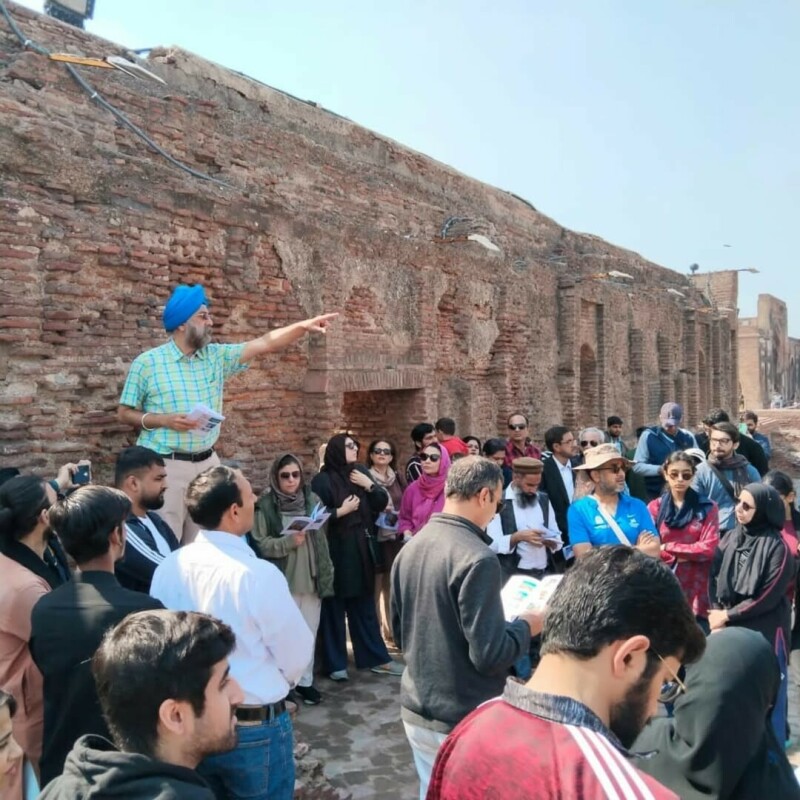
In an effort to deepen the understanding of Lahore Fort’s historical significance during the Sikh era, the Walled City of Lahore Authority (WCLA) has enlisted the expertise of Dr. Tarunjit Singh Butalia, a distinguished researcher based in the United States, to author a comprehensive tour guidebook.
Dr. Butalia, who has previously explored the Lahore Fort’s rich tapestry during the Sikh Empire, recently led a walking tour for various stakeholders, including media representatives, to showcase the architectural and historical marvels of the site. This new guidebook is a collaborative effort between the WCLA and Dr. Butalia, aimed at offering visitors a self-guided experience that can be completed in approximately three hours, or extended to five or six hours to include visits inside the monument’s interiors.
Dr. Butalia’s connection to the region is deeply personal, with ancestral ties to Gujranwala and a family history intertwined with the Sikh Empire’s governance at Lahore Fort. His passion for Sikh historical sites is a lifelong pursuit, invigorated by his research and discoveries about the fort’s storied past.
The Lahore Fort, initially a mud fort, was developed by Mughal emperors Akbar, Jahangir, Shah Jahan, and Aurangzeb before being seized by Ranjit Singh in 1799. Under Sikh control until 1849, the fort saw preservation and new constructions by successive Sikh leaders, including notable additions such as the Hazuri Bagh and the Gurdwara Dera Sahib, built in honor of Siri Guru Arjan Sahib.
Dr. Butalia’s journey into the fort’s history was sparked by a passage in a 1920 publication that mentioned a detailed map from the Sikh period. This discovery led him on a global quest to uncover historical maps and documents. Among his findings was a rare copy of the Kamruddin Sikh Era Map, which provided detailed insights into the fort’s layout during the Sikh period.
His extensive research involved indexing the Umdatut Tawarikh, the official court diary of the Lahore Darbar, and other Persian sources, revealing that the fort was often referred to as Shahi Qila or Qila Mubarak during the Sikh era. The guidebook will categorize approximately 100 monuments by their Sikh-era names and historical context, offering a detailed exploration of the fort’s heritage.
The WCLA plans to train over 20 tour guides to utilize this new publication, enhancing the visitor experience at Lahore Fort. The guidebook promises to be an invaluable resource for those seeking to delve into the fort’s Sikh-era legacy.