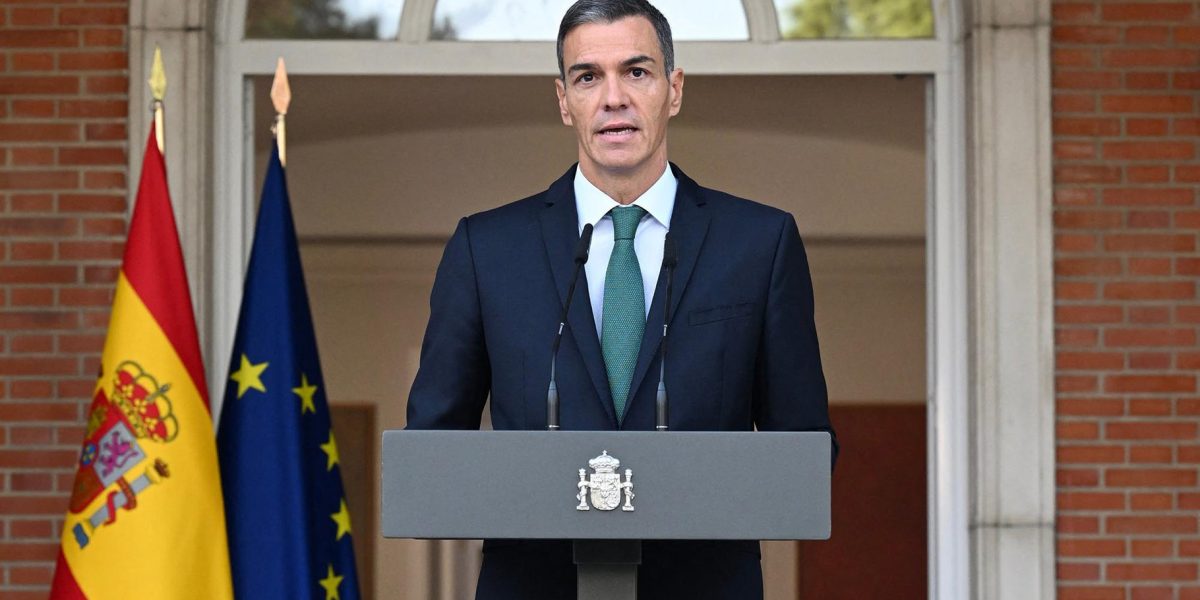
Spanish Prime Minister Pedro Sánchez announced Monday that he is dissolving parliament and calling early general elections for November 29, just three days after lawmakers rejected his government’s package of measures aimed at tackling the country’s housing crisis.
The decision opens a new political chapter in Spain, where the next general election had originally been expected in mid-2027.
“I have decided to convene an extraordinary Council of Ministers this morning to dissolve the chambers and call general elections to be held on Sunday, November 29,” Sánchez said in a solemn address from the Moncloa Palace, his official residence.
Call for a Broader Progressive Majority
The socialist leader, in power since 2018, framed the snap vote as a bid to secure a stronger mandate for his reform agenda.
“To carry out in depth the pending reforms that we need… we must mobilize and obtain a much broader, progressive majority from parliament, with which we can make the elites bend, conquer new social progress and continue transforming Spain,” Sánchez said.
Political Setback Over Housing Measures
The surprise announcement follows a harsh political defeat on Friday in the Congress of Deputies, which once again highlighted the difficulties facing Sánchez’s minority coalition government in passing legislative initiatives.
The government had sought to push through a package of measures amid a wave of protests triggered by the eviction of Maricarmen Abascal, an 87-year-old woman who became a symbol of the housing access problems that have affected Spain for years.
The Madrid resident was forced to leave the apartment where she had lived for seven decades after her building was acquired by an investment company that intended to raise her rent by 275 percent.
The government’s defeat outraged those protesting against an increasingly expensive housing market, and on Saturday tens of thousands of people demonstrated for the right to decent housing in Madrid and dozens of other Spanish cities.
Hundreds of protesters have been camping for more than a week in the Puerta del Sol, in the heart of Madrid, to press for reforms.
Polls Point to Defeat
After eight years in power, Sánchez has also been weakened by corruption scandals involving people in his inner circle, including his wife and close associates of his Socialist Party.
He has additionally faced widespread criticism over his handling of the crisis in the North African enclave of Ceuta, where thousands of migrants from Morocco surged across the border in late July.
The most recent opinion polls place the main conservative opposition Popular Party (PP) ahead of the Socialists. But the PP would not win an absolute majority and would therefore need to negotiate with the far-right Vox, currently Spain’s third political force.
Given the government’s weakness, the PP had been regularly demanding early elections for months. PP leader Alberto Núñez Feijóo again called on Sánchez on Saturday to call a vote, saying the country “can’t take any more.”
Housing Crisis at the Heart of Discontent
As in many European countries, the lack of affordable housing is one of the main social problems in Spain, where tourism platforms such as Airbnb and investment funds are accused of driving up prices by buying real estate and reducing supply for residents.