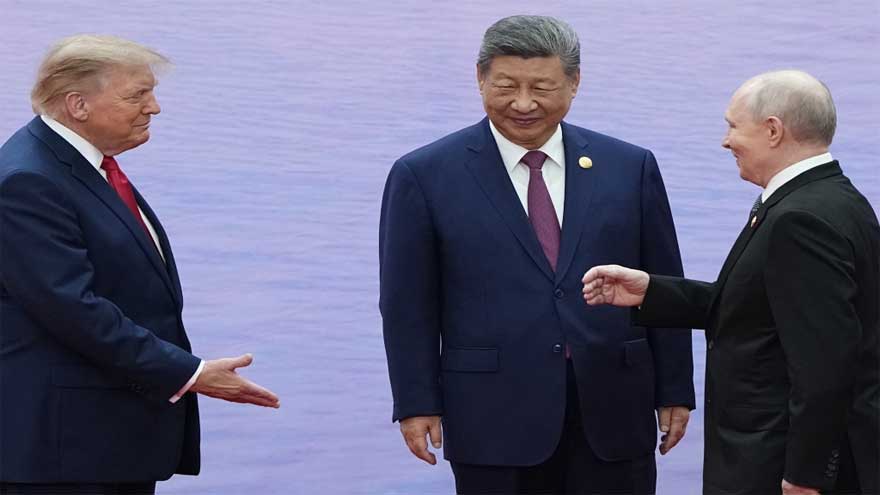
Chinese President Xi Jinping will host US leader Donald Trump and Russia’s Vladimir Putin on Thursday for a keenly anticipated first trilateral summit, a meeting expected to centre on the world’s major international conflicts.
The gathering comes at a fraught moment: Russia’s years-long offensive in Ukraine continues to grind on, Trump is entangled in his war with Iran, and an ascendant China is looking to strengthen its hand in East Asia.
Fears of a Spheres-of-Influence Deal
The conclave has stoked fears that the three powerful men may seek to divide the globe into spheres of influence — for example, by making decisions on Ukraine’s fate without consulting Kyiv or Europe.
Such concerns have been amplified by the secrecy surrounding the agenda and by the differing accounts each capital has offered of what will be discussed.
Conflicting Agendas
Xi, Trump and Putin are expected to convene on Thursday afternoon on the sidelines of the Asia-Pacific Economic Cooperation (APEC) forum, a grouping of 21 economies around the Pacific rim.
- Washington initially signalled that Ukraine was off the table, before Trump said the war would feature in the talks.
- Its inclusion would be a mild surprise, given that Xi does not view the conflict as China’s problem and Beijing has refused to condemn the invasion.
- The Kremlin has said the agenda has not been finalised, but acknowledged it would be hard to avoid discussing Ukraine.
The meeting is set to last “no more than an hour,” according to Russian officials — a tight timeframe for three leaders with sharply diverging priorities and deep mutual suspicions.
A Test of Global Order
For Kyiv and its European allies, the summit represents a critical test. Any hint that the three leaders might negotiate over Ukraine’s future without Ukrainian or European participation would deepen anxieties in capitals already wary of Washington’s shifting posture.
For Beijing, the meeting offers a stage to cast itself as a global power broker alongside Moscow and Washington — a role it has long sought but rarely been granted so visibly. For the Kremlin, it is a chance to demonstrate that Russia remains indispensable to any global settlement despite its isolation in the West.
And for Trump, the summit presents both an opportunity and a risk: a chance to project himself as a dealmaker on the world stage, but also the prospect of being drawn into a three-way dynamic in which China and Russia may seek to align their positions against American interests.
What emerges from the roughly one-hour session may not be concrete agreements, but the symbolism alone — three leaders of the world’s most powerful nations seated at one table — is likely to shape international expectations for months to come.