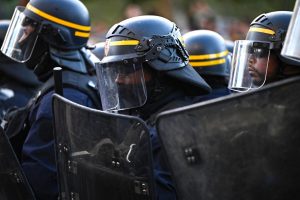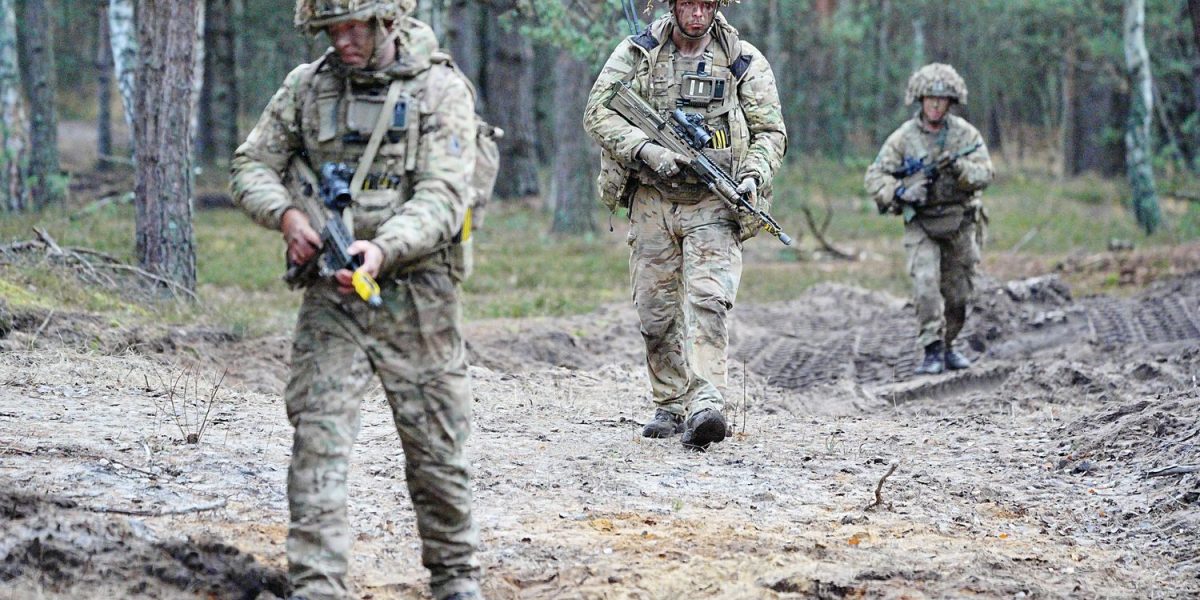
Nearly 2,800 soldiers from across Europe gathered in a Polish forest this month for the first live field exercise of the Coalition of Volunteers, the 37-nation force led by France and Britain that aims to shore up Ukraine’s defenses. Almost half of the troops deployed are French.
The drill, codenamed “Koalicja,” runs from November 9 to 22 in Nowa Dęba, southeastern Poland, under joint French-British command. It comes as Moscow announced Tuesday that it had intercepted 1,441 Ukrainian drones in overnight attacks across its territory, and as Kyiv reported severe damage to the Kerch Bridge in what President Volodymyr Zelensky called an “unprecedented” operation.
A logistical proving ground
The training ground lies barely an hour’s drive from the Ukrainian border, and the surrounding woodland closely resembles the terrain troops would face inside Ukraine. On the firing ranges, Belgian and French soldiers exchanged weapons, while Dutch units set up anti-drone netting, British personnel assembled a medical post and Estonian troops moved armored vehicles into position.
“We are learning to bring a whole set of capabilities to Poland as quickly as possible by air, by sea and by train. It is a real logistical and administrative challenge,” said General Bruno Helluy, commander of the 1st Division based in Besançon, France.
“What we want to demonstrate here is our capacity to do it, to do it quickly, and to do it together,” he told reporters.
Eight nations are deployed on the ground for the exercise. “Today we have 2,800 troops, and it could rise to 10,000, with capabilities consistent with what is happening on the other side of the border: drones, counter-drone systems, protection. We need to train,” Helluy added.
French forces test layered air defense
French units are responsible for multi-layered air defense during the exercise, operating an aerial bubble built around some 150 drones tasked with surveillance, detection and target designation. For the first time, a combat squadron is operating as a coordinated swarm.
“A queen drone gathers information on the ground and transmits it to the worker drones so they can destroy fixed or moving targets at low cost, day or night,” Helluy explained.
The small, agile drones carrying munitions were piloted by dozens of soldiers who had set aside their rifles. “The immersive view from the drone now allows us to fly it in real time,” one operator said, describing the sensation of seeing through the aircraft’s camera.
A hundred meters away, British troops tested a handheld detection system. A senior officer said the United Kingdom has invested heavily in the exercise and in the multinational force to make it credible and ready.
Not a show of force
Both commanders stressed that the drill is not a combat mission. “Everything political and strategic — support for a ceasefire — is not our remit,” Helluy said. “We are not a combat force at all, and certainly not a peacekeeping mission. We are here to reassure the Ukrainian population and to support the regeneration of the Ukrainian armed forces after a cessation of hostilities,” his British counterpart added.
Russia has so far refused to engage with the coalition’s existence, though Helluy noted that this is beyond the military’s control. Moscow has previously said that the presence of French soldiers on the ground would amount to “direct participation” in the conflict.
The “Koalicja” exercise is therefore less a demonstration of force than a demonstration of Europe’s willingness and capacity to take part in resolving the war.