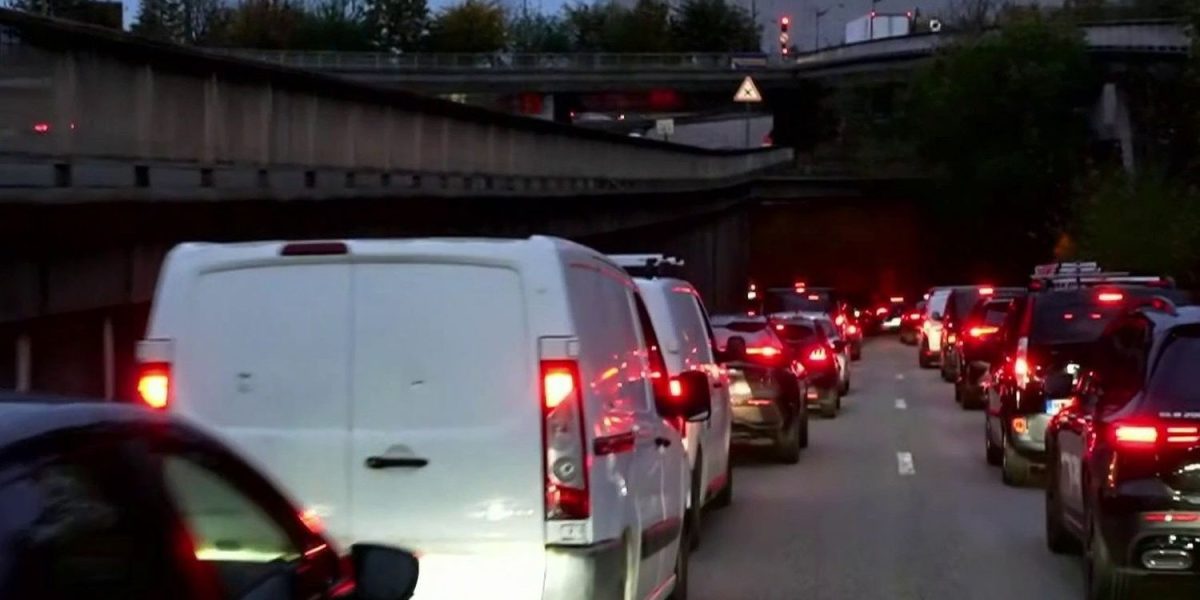
The partial closure of the A13 motorway on the western edge of Paris has plunged Île-de-France into traffic turmoil, with some 330 kilometres of cumulative congestion recorded on the evening of Monday, 16 November alone. The shutdown, which began that morning at the exit from Paris towards Normandy, is set to last until the end of August 2027.
The cause is the Saint-Cloud tunnel, a nearly century-old structure that normally carries more than 80,000 vehicles a day. Inspectors deemed its condition alarming, with cracks of close to 40 centimetres, making a nine-month repair programme unavoidable.
Drivers Report Doubled Journey Times
For regular users, finding an alternative route has already become a headache. Two official diversion routes have been designated, including the A14, which has been made toll-free from Monday to Friday.
“I don’t even know which way to go any more. This is the second time I’ve been driving round in circles. Some streets are closed and the signs are very hard to follow,” one motorist said. Another added: “It’s worse than usual. It was long, very long.” A third commuter reported: “I work near Boulogne and it normally takes me 20 minutes to get home. Now the time has doubled.”
Neighbouring Towns Fear Overflow Traffic
A prefectoral order now bans through-traffic in surrounding municipalities in an effort to prevent the secondary road network from becoming saturated. Residents of Neuilly-sur-Seine in the Hauts-de-Seine are nonetheless bracing for worse congestion in their streets.
“If there are too many people, then yes, it’s bound to be unpleasant for residents,” one local woman said. Another passer-by was resigned: “It’s going to be a shambles either way. They’re closing a major artery.”
Mayor Jean-Christophe Fromantin warned that the town simply cannot absorb the overflow. “Traffic jams very quickly, because we’re talking about tens of thousands of vehicles. If we get that volume in the rest of the town, we block the town,” he said.
GPS Apps Agree to Steer Drivers Away
Navigation apps have pledged to cooperate, offering users only the officially recommended routes in order to prevent traffic being displaced into streets incapable of handling additional volumes. A restricted traffic zone has also been established, barring heavy goods vehicles from the secondary routes, with police tasked with enforcing it.
The disruption is expected to weigh on commuters across the region for the best part of a year, as authorities urge drivers to plan ahead and make use of public transport where possible.