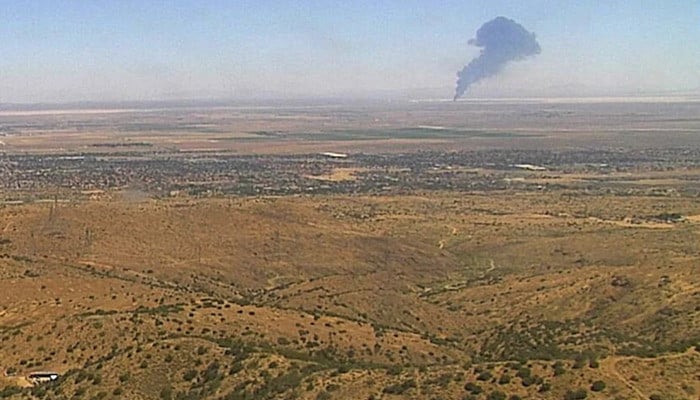
A catastrophic crash at Edwards Air Force Base claimed the lives of all eight crew members aboard a B-52 Stratofortress on Monday, as the iconic long-range bomber burst into flames during a routine test mission. The accident, which sent a massive pillar of black smoke billowing over California’s Mojave Desert, marks the first fatal incident involving the airframe in a decade.
The Boeing-built, eight-engine jet was attempting takeoff when it crashed on the runway, Air Force Colonel James Hayes confirmed in a press conference. The aircraft was immediately engulfed in flames, and officials quickly deemed the wreckage unsurvivable. Aerial footage of the scene revealed a charred, smoldering scar on the desert floor larger than a football field, with no large debris visible from a distance.
A Mixed Crew Lost in a Modernization Flight
The flight was supporting a radar modernization program, a critical upgrade for the aging bomber fleet. Colonel Hayes described the victims as a “mixed crew” composed of government civilians, government contractors, and uniformed military personnel. Aerospace giant Boeing, which originally designed and built the Stratofortress, confirmed that two of its employees were among the dead. Officials are withholding the names of the victims pending notification of next of kin.
The scale of the destruction led to an immediate suspension of all flight operations at Edwards. Damage to the runway prompted Colonel Hayes to ground activities through at least Tuesday, though he clarified that no operations beyond the base would be affected. The cause of the crash remains unknown and is under active investigation.
The Backbone of Strategic Deterrence
The B-52 Stratofortress served as the backbone of the U.S. crewed strategic bomber force for decades. The subsonic, swept-wing aircraft is capable of carrying up to 70,000 pounds of mixed ordnance, ranging from precision-guided missiles and cluster bombs to nuclear warheads, with a combat range exceeding 8,000 miles without refueling.
This incident is the first crash of a B-52 since May 2016, when a bomber went down on the island of Guam. All seven crew members aboard that aircraft survived. The jet involved in Monday’s tragedy was assigned to the 412th Test Wing, the host unit at Edwards. While most operational B-52s are stationed in North Dakota and Louisiana, Edwards serves as the Air Force’s premier test flight facility.
A Historic Base Scarred by Tragedy
Edwards Air Force Base, a sprawling 481-square-mile installation built around a dry lake bed, holds a legendary place in aviation history. It was here that Chuck Yeager first broke the sound barrier in 1947, and where NASA’s space shuttles made their earliest landings. Monday’s crash adds a somber chapter to that legacy, with the base now focused on recovery and a meticulous investigation into what brought down one of the military’s most enduring warplanes.