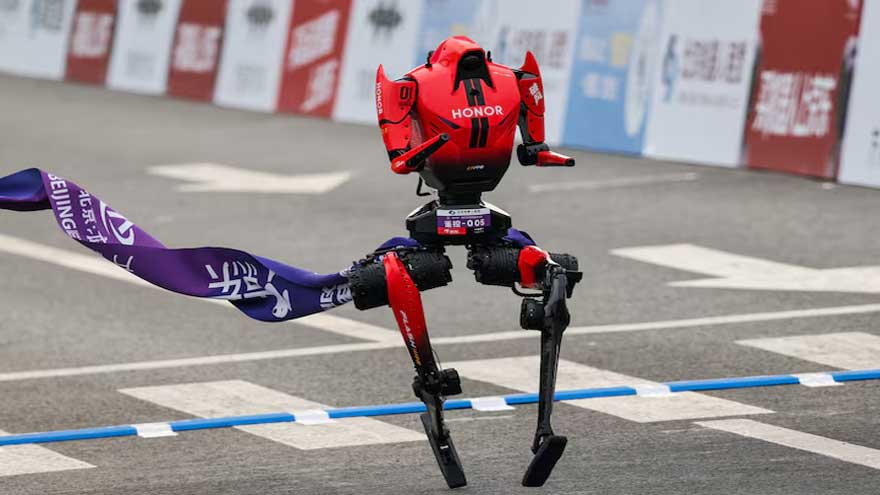
A Chinese humanoid robot has sprinted into the record books, covering 100 metres in a blistering 9.39 seconds at the World Humanoid Robot Games in Beijing on Saturday. The time, clocked in a preliminary heat, eclipses the men’s world record of 9.58 seconds set by Jamaican sprint legend Usain Bolt at the 2009 World Athletics Championships in Berlin.
Tiangong Ultra, developed by the Beijing Humanoid Robot Innovation Center, surged past rival machine Lightning near the finish line to win its heat. Lightning, built by smartphone maker Honor, crossed in 9.47 seconds—also under Bolt’s historic benchmark. Organisers confirmed the results at the opening of the games’ second edition.
Rapid Progress in Robotic Athletics
The performance marks a dramatic leap from last year’s inaugural event, when Tiangong Ultra took 21.50 seconds to complete the same distance. The robot also won the world’s first humanoid half-marathon in Beijing last year, signalling rapid advances in bipedal locomotion and balance control.
Earlier on Saturday, Chinese state media reported that Lightning had posted a 9.32-second run in a preparatory test, hitting a peak speed of 14.5 metres per second. Lightning claimed victory in this year’s humanoid half-marathon with a time of 50 minutes and 26 seconds—faster than the elite men’s human world record pace over that distance.
Engineering Behind the Speed
Lightning stood 169 cm tall with 95-cm legs during the half-marathon. Researchers later extended its legs by 10 cm to 1.05 metres ahead of the games, according to state broadcaster CCTV. The adjustment appears to have paid off, boosting stride length and top-end speed for the sprint events.
The 100 metres is one of 51 events at this year’s games, which also feature football, dancing, and industrial-task competitions. The event has drawn 2,056 robots from 666 teams across 16 countries and six continents, a sharp increase from 280 teams at the inaugural edition. The games run through Wednesday at Beijing’s National Speed Skating Oval.
China Bets Big on Humanoid Robots
China has designated humanoid robots as a strategic emerging industry, with policymakers and companies betting that advances in artificial intelligence and hardware will accelerate their adoption in manufacturing, logistics, and consumer applications.
Investor enthusiasm was on full display earlier this week when shares in Unitree, China’s best-known humanoid robot maker, surged more than fivefold in their Shanghai trading debut, giving the company a market value of about $50 billion. The fervour underscores growing confidence that humanoid robots will become a cornerstone of the country’s technological ambitions.