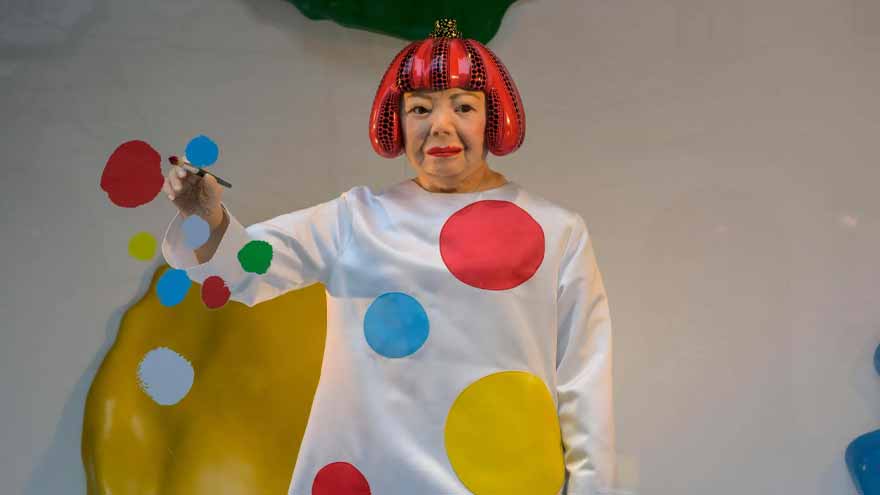
Japan’s Yayoi Kusama, one of the world’s most celebrated contemporary artists, has died aged 97, her company said Thursday, triggering tributes from fans around the world. The artist, often called the “polka dot queen,” passed away on August 14 in a Tokyo hospital.
Kusama channelled hallucinations and trauma into vibrant art featuring her trademark dots, nets and infinity motifs over a career spanning decades. Her death was confirmed in a statement that described an extraordinary lifetime devoted entirely to artistic creation.
A Life Defined by Art and Obsession
“Throughout an extraordinary lifetime devoted entirely to artistic creation, Kusama pursued an internationally acclaimed career as a pioneering avant-garde artist whose creative practice encompassed visual art, performance, fiction, and poetry,” the statement said.
“She continued to paint until her final days, never setting aside her brush, and continued exploration of forever love and eternal soul,” it added.
Born in 1929 as the youngest daughter of a wealthy family, Kusama began producing her signature art at age 10. Her early experiences with hallucinations shaped her unique visual language.
“One day, after seeing a tablecloth with a red flower pattern on a desk, I saw the same red flower pattern all over the ceiling, windows and pillars. It filled the room, and covered my body,” she wrote in her autobiography.
From Japan to New York’s Avant-Garde Scene
Instantly recognisable in her bright red wig and bold spotted outfits, Kusama’s exuberant work was the expression of a long battle with mental illness. After studying art in Japan, she moved to the United States in the late 1950s and rose to prominence in New York’s avant-garde scene.
Despite facing discrimination as a Japanese woman, she won fame for bold, big paintings and provocative 1960s “happenings” featuring body painting and polka dots. She also launched a fashion line, established a “Church of Self-Obliteration” and styled herself the “High Priestess of Polka Dots” to officiate at a gay wedding.
Returning to Japan in the 1970s, Kusama voluntarily entered a Tokyo psychiatric hospital, where she lived — and worked — for the rest of her long life. Her pumpkin sculptures — including one on Japan’s “art island” Naoshima — infinity rooms and immersive installations attracted huge crowds and sold for millions of dollars.
Visions That Became a Global Legacy
According to her website, “visions and hallucinations” beginning in her childhood engendered her first polka-dot and net-themed drawings, giving her a unique style from the start.
“She formulated a philosophy of art she dubbed ‘self-obliteration’ based on simple motifs of obsessive repetition and proliferation,” it says.
Fans around the world shared tributes on social media. “I’ve had the privilege of viewing her paintings and your works several times. Bold, delicate, beautiful. That world was one I had never known. And to me, she was also someone truly endearing. May you rest in peace,” said one Japanese X user.
An Enduring Influence on Contemporary Art
Kusama’s influence extends far beyond the art world. Her immersive installations, particularly the “Infinity Mirror Rooms,” have become cultural phenomena, drawing millions of visitors to museums worldwide. Her work consistently broke auction records, with paintings and sculptures fetching tens of millions of dollars.
Her ability to transform personal suffering into universally resonant art made her a symbol of resilience and creative freedom. From her early days in Matsumoto, Japan, to her decades in New York and eventual return to Tokyo, Kusama never stopped creating.
Her company said she died in hospital in Tokyo. The statement did not disclose the cause of death. Kusama is survived by a global community of admirers, collectors, and fellow artists who will continue to find meaning in her infinite dots and boundless imagination.