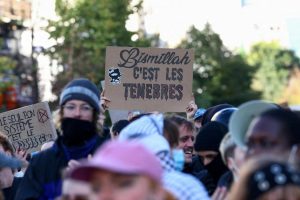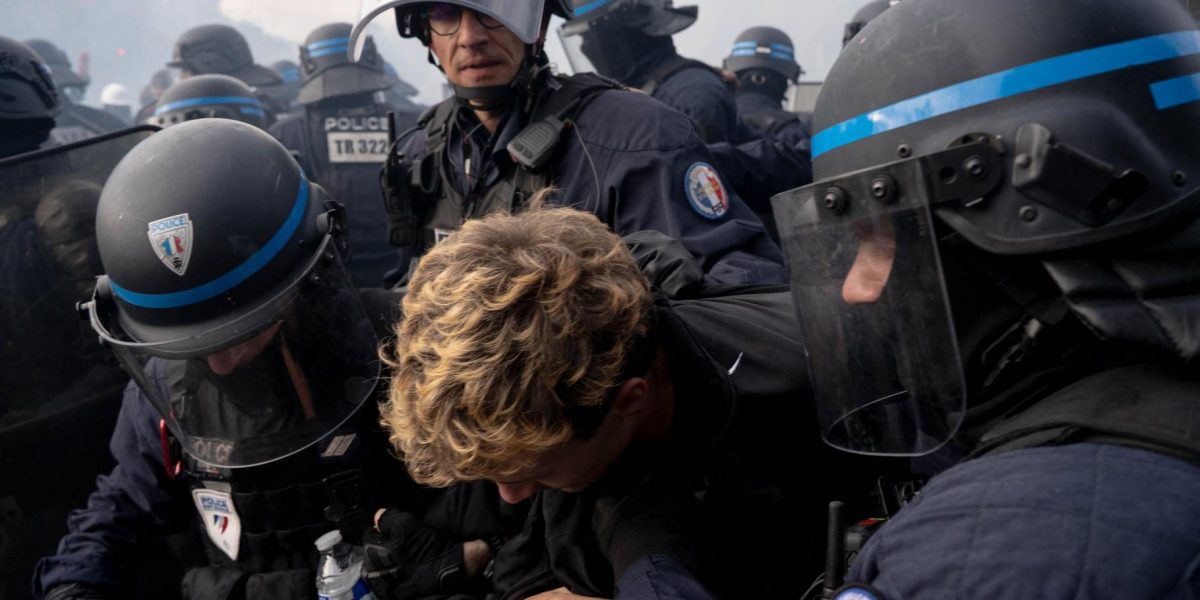
No social mobilization in recent French history has been met with such a violent response. Beyond four teenagers seriously injured — one who lost a hand, two wounded in the eye, and a fourth with a broken jaw — and the opening of 24 investigations by the IGPN, the national police oversight body, another figure stands out: the number of arrests.
On Friday, October 9, the Ministry of Justice announced that more than 6,800 people had been taken into custody since the high school protest movement began in mid-September. According to the AFP news agency, 86 percent of those detained are minors.
The figure alone is striking, but it appears even more staggering when compared to other large-scale social movements. During the Yellow Vest protests, the average was 460 arrests per day, compared with 450 during the riots that followed the death of Nahel in 2023, according to franceinfo. That is far below the 1,000 daily detentions recorded since the student revolt began.
A Strategy of ‘Neutralization’
“It’s unprecedented, without precedent. These arrests are also a form of police violence,” said Michel Kokoreff, a sociologist and university professor at Paris 8, in an interview. For him, they constitute a form of “diversion.”
“By extracting these young people from the field, they neutralize them for a day or two, depending on how long their custody lasts,” he explained. The hope, he said, is that this will dissuade them from returning. It is a strategy that may have a deterrent effect on an individual level, “but not collectively,” analyzed the author of the book Émeutes (Anamosa).
“The goal is to smother the protest movement under the mass of arrests. It’s a form of deterrence through threat,” echoed Sebastian Roché, a political scientist and research director at the CNRS, in the pages of Ouest-France. “A good police force, according to Laurent Nuñez, is one that carries out many dispersal charges and arrests.”
Allegations of Humiliation in Custody
The grounds for arrest have varied widely, from property damage to violence on public roads. “I’m not proud of what she did, but I find this totally disproportionate. Three men arriving, arresting her, and then she spends the night without being able to speak to anyone,” a mother whose daughter was arrested for brandishing an anti-police slogan told franceinfo.
Some students have reported experiencing physical and psychological violence during their detention. Their lawyers, speaking to AFP, denounced custody measures designed to “terrorize.” “There are systematically attempts at humiliation,” said attorney Pascual, who described how a teenage girl was “taken to the police station barefoot” after she had “asked officers” to retrieve her shoes, which were lost during her arrest. “They make them crawl like a dog to pick up their belongings,” said attorney Ancion, representing one of the detained teenagers, who also denounced racist insults and psychological abuse.
At this stage, out of nearly 7,000 arrests, 2,376 people face prosecution and 65 percent have been brought before a judge. Twenty-one pretrial detentions have been ordered, involving 15 adults and 6 minors, the Justice Ministry announced via AFP.
Government Defends ‘Proportionality’
How does the government explain these record arrests? Interior Minister Laurent Nuñez offered a partial answer during the 8 p.m. newscast on TF1 on Friday, October 2. “When there is damage, unrest, violence, there are interventions by law enforcement, which have led us to make arrests. Since Monday, that’s more than 5,000 people. So systematically, there were interventions to put an end to disturbances to public order.”
Was a systematic order to arrest issued? Contacted repeatedly, Nuñez’s office did not respond.
In public, the Interior Minister repeats that the police response comes down to one word: proportionality. “There is a need to intervene when there is violence, in a manner adapted to the public and with even greater proportionality,” he told the Law Commission on Thursday, October 7. While Nuñez acknowledged the serious injuries and the unprecedented nature of the movement, he denied any “police repression.” During the same hearing, he explained that intermediate weapons were “indispensable” because they allowed for “a gradation in response and staying at a distance.”
A Break From Longstanding Doctrine
This vision of the situation appears to run counter to the doctrine that has been in place for a decade, a period during which a shift toward increasingly violent repression is said to have occurred.
Equipped with shields and protective gear, armed with batons, tear gas, and LBDs, officers are encouraged to engage at close quarters. “Since May 1968, the police have been obsessed with protecting their own ranks. There is no desire for dialogue or de-escalation. Yet that is what is written in the 2022 doctrine,” said Kokoreff. “But what we see on the ground and in the images being broadcast are officers wading into the crowd.”
France stands out as an exception in how it manages social movements. When discussing crowd control, Spanish authorities prefer the term “crowd management,” the professor noted. Notably, only France and neighboring Belgium are authorized to use LBDs.