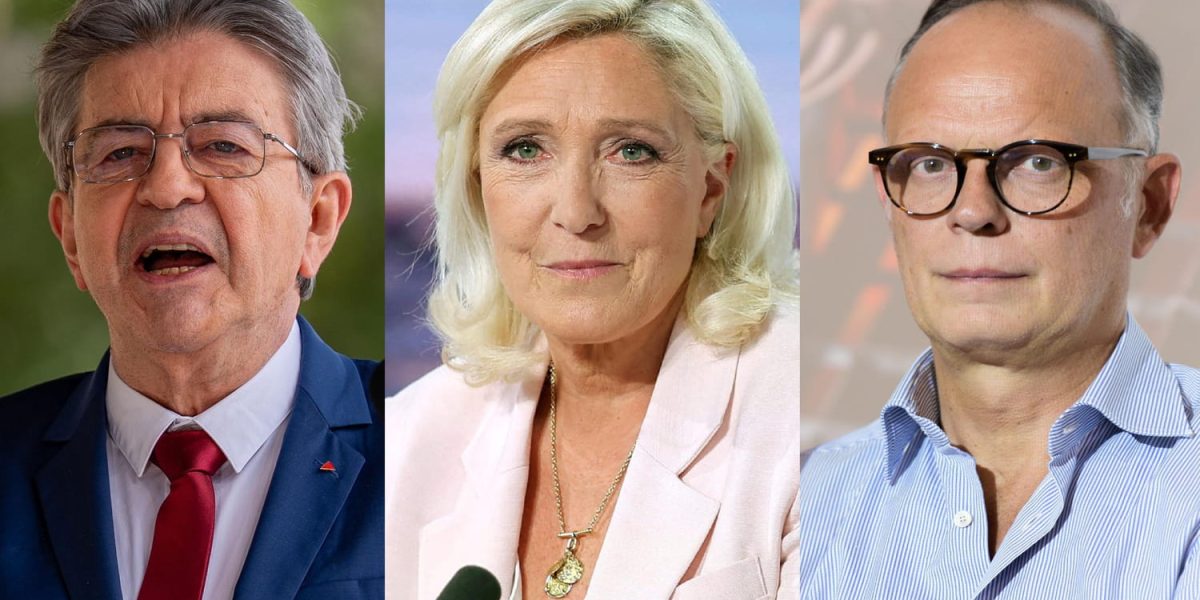
Six months before France goes to the polls, the 2027 presidential campaign is already in full swing, driven by labor unrest and international conflicts that candidates are seizing upon to float early proposals ahead of formal program launches. The election is scheduled for two rounds on Sunday, April 18 and Sunday, May 2, 2027.
While the field of contenders is broadly known, it is far from final. New names could still enter, and some hopefuls may step aside in favor of alliances with better-placed candidates. The question is especially acute on the right and in the center, where a revived primary proposal championed by Gabriel Attal — and now backed by Bruno Retailleau — is still being rejected by Édouard Philippe.
Marine Le Pen’s candidacy has also been called into question after a magistrate argued that the National Rally (RN) leader is subject to ineligibility until a Court of Cassation ruling, a claim she denies.
Polling: Le Pen in Command
Across polling institutes, the RN leads the first round comfortably, with voting intentions ranging between 31 and 37 percent. The candidate is sometimes credited with a 20-point lead over her rivals.
Surveys are less consistent on who would join her in the second-round runoff. After initially casting Édouard Philippe as best placed to face Le Pen, polls later showed a tight battle between the Le Havre mayor and Jean-Luc Mélenchon — and even a three-way contest with Raphaël Glucksmann after his Socialist Party primary victory. In the latest studies, the left-wing firebrand has pulled ahead, with scores between 15 and 20 percent and a regular two- to three-point edge over his competitors, widening to seven points in the most favorable scenarios.
Second Round: Le Pen Favored in Every Scenario
For the runoff, polls again give the advantage to Marine Le Pen, with the far-right party projected to win in every scenario tested. Her widest margin would come against Jean-Luc Mélenchon, where she is often credited with more than 60 percent of voting intentions against 30 to 35 percent for the leftist. Against Édouard Philippe, her score is narrower but still above 50 percent, typically between 52 and 55 percent.
Campaign Trail: Primary Row Deepens
Édouard Philippe doubled down on his refusal to take part in a right-and-center primary during an interview with Franceinfo on Thursday. “I made my decision many months ago, saying I would not submit to a primary and would present my candidacy to the French people. And I am not a man to change my mind with the shifting circumstances,” he said, adding that “a little constancy and coherence does no harm when one aspires to preside over the destiny of France.” Asked whether he might withdraw before the election if he failed to gain traction in the polls, Philippe said he was “a political leader trying to be responsible” and believed his rivals “will know how to be so too.”
Bruno Retailleau, the LR presidential candidate, said on franceinfo that the primary should go ahead with or without Philippe, refusing to grant the Le Havre mayor “the right of life or death over an attempt to settle the contest so we can achieve greater unity.” He added: “I think the French will judge very harshly whoever prevents” the primary.
Meanwhile, the RN urged traditional right-wing voters to defect, writing on X that “Bruno Retailleau is preparing an alliance with those he claims to fight” and that “the only vote for change is Marine Le Pen.”
Mélenchon’s Book Tops Best-Seller Lists
Jean-Luc Mélenchon’s campaign book has topped best-seller charts six days after release. According to his campaign team, the initial print run of 80,000 copies “sold out within hours” on launch day. Clémence Guetté said on X that the book is “currently number one in ALL points of sale,” and figures from Livres Hebdo confirm it leads sales, ahead of Philippe Jaenada’s Goncourt-winning novel. Publisher La Dispute has raised the print run of the 160-page, €4.90 volume to 300,000 copies to meet demand.
Socialist Dissident Stays the Course
Karim Bouamrane, the Socialist mayor of Saint-Ouen running as a dissident Socialist candidate, has kept a lower media profile of late but insisted on CNews that he “believes in [his] candidacy and in the victory of the social-democratic bloc.” Referring to recent social unrest, he said: “Our country suffers too much from contempt toward young people, retirees… This crisis among high school students was the quintessence of contempt from those in power.”
What’s Next
The next presidential election will be held in April 2027 over two rounds, with exact dates yet to be set. A new leader will succeed Emmanuel Macron, who cannot run again after two consecutive terms. The contest will be fought among the three major blocs represented in the National Assembly — the left, the center, and the right and far right — though these groups remain divided over who is best placed to represent them and win the presidency.