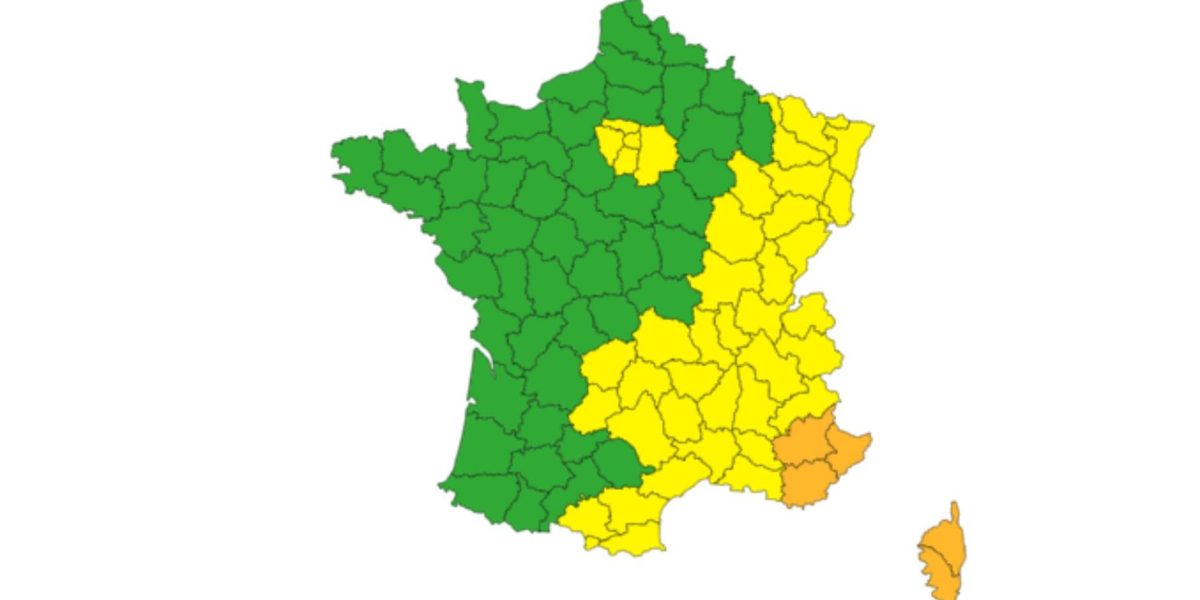
The brutal heat wave that suffocated France is finally retreating. For the first time in days, no department remains under a red vigilance warning for extreme heat, and most orange alerts were lifted early Monday morning, according to Météo France.
The Île-de-France region and departments including Bas-Rhin, Haut-Rhin, Ain, Haute-Savoie, Rhône, Savoie, Isère, Drôme, and Ardèche were all downgraded to yellow vigilance at 6:00 a.m. The mass downgrade signals a significant shift in the weather pattern, as cooler air pushes in from the west and northwest.
Southeastern Hotspots Endure Scorching Temperatures
Despite the widespread relief, five departments remain locked under an orange alert: Alpes-de-Haute-Provence, Alpes-Maritimes, Var, and the two Corsican departments. Forecasters predict maximum temperatures between 34°C and 37°C across the Mediterranean coast and Corsica, with the Var department potentially hitting a blistering 40°C.
The orange storm vigilance was also lifted Monday morning, but the meteorological drama is not entirely over. After violent overnight thunderstorms, Météo France warns that new storm episodes are expected Monday afternoon over the Pyrenees, the Massif Central, and the eastern mountain ranges.
In its latest bulletin, the national forecaster noted that the heat wave will continue to gradually recede. “The hottest air will progressively shift towards the east of the country, as fresher air advances from the west and northwest,” the agency stated.
Death Toll Emerges as Officials Fear a Second Wave
As the immediate crisis eases, the human cost is coming into focus. Santé publique France has recorded approximately 1,000 excess deaths since Wednesday compared to previous months—a preliminary toll that is expected to rise. Health Minister Stéphanie Rist sought to reassure the public on Sunday, telling BFMTV that the country will “probably not see the same excess mortality” as the catastrophic 2003 heat wave, which claimed 15,000 lives.
“In 2003, we did not have the same medical knowledge regarding heat waves. We also did not have the state organization or the organization of our nursing homes, for example,” Rist explained.
Health authorities are particularly alarmed by a sharp increase in deaths at home, which have surged by nearly half compared to normal levels in recent days. The underscores the vulnerability of isolated individuals during extreme weather events.
The reprieve may prove short-lived. Météo France has flagged the week of July 6 to13 as a period of heightened concern, stating that “the scenario of high heat over the country becomes more probable,” even if the intensity remains uncertain for now. The prospect of a rapid return to dangerous temperatures is keeping emergency services and public health officials on edge.