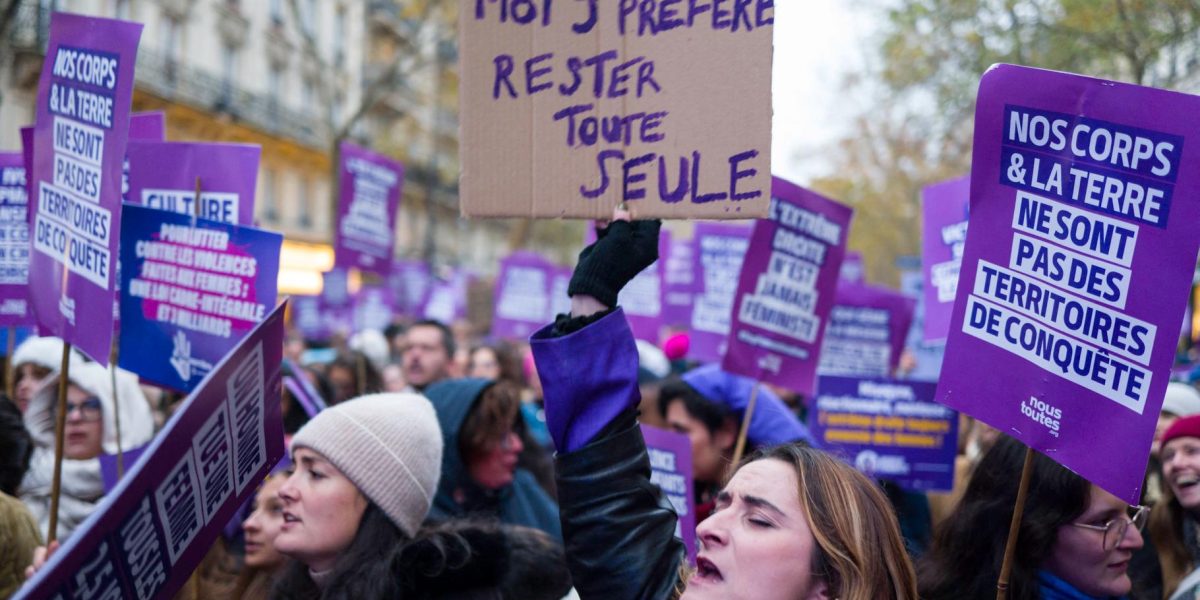
The day after French lawmakers adopted the so-called “integral” law against sexist and sexual violence, the feminist movement found itself split, with some organizations hailing a historic step forward and others warning the text falls far short of what is needed.
Members of the Feminist and Childist Coalition welcomed what Anne-Cécile Mailfert, president of the Women’s Foundation, described to Le Parisien as “a historic milestone victory that does us good.” She pointed to major advances, including the recognition of incest, forced marriage and female genital mutilation as forms of sexual violence, as well as significant progress on judicial matters. Mailfert said she hoped for a swift “final victory” once the text is definitively adopted.
That satisfaction is far from unanimous. “We are worried, and the fight continues because this bill is not the solution to systemic gender violence in France,” Emmanuelle H., a member of the collective #NousToutes, told HuffPost. The collective is leading the opposition to the text alongside organizations including Médecins du Monde, Inter-LGBT, Toutes des femmes and Amnesty International France. “This law is integral in name only,” they said in a joint statement.
Criticism of a Punitive Approach
Like the left-wing France Unbowed lawmakers who largely abstained in the vote, critics take issue with many aspects of the bill, beginning with its underlying philosophy.
“If passed, the law may ease the judicial path for some victims, but it is far from solving the problem because the punitive aspect was prioritized. There are no prevention measures — those long championed by associations were completely ignored because they cost money,” Emmanuelle H. said. Funding in the text is also largely insufficient, she added.
“With this bill, an entire group of victims is forgotten, starting with those who do not file complaints. But also vulnerable people — for example those living with disabilities, those with precarious administrative status, LGBTQIA+ people and sex workers,” she said.
Scrapped Residency Protections Raise Alarm
The removal of Article 62, on a proposal from the far-right National Rally, is particularly telling. The provision would have allowed a victim of sexual violence to obtain a residence permit for the duration of legal proceedings.
On this point, the Feminist and Childist Coalition also called for “correcting” what it described as a “setback”: “No victim should give up filing a complaint for fear of deportation.”
Concerns Beyond 2027
More broadly, #NousToutes is worried about the political calendar in which the text is being debated, at the end of Emmanuel Macron’s second term.
“He made gender equality the great cause of his terms, but he never stopped showing contempt for victims and associations, which have kept losing funding,” Emmanuelle H. said. “So with this law, we are in total hypocrisy. Strategically, it was not the right time to discuss a framework law to fight gender violence.”
Her fear is that the advances in the text, which critics consider too modest, could block other urgent reforms. “Tomorrow, when the associations supporting the text say ‘We don’t have the means to implement the measures the text provides for,’ they will be told, ‘That’s enough, you already got your integral law!'” she predicted. “If this is meant to silence feminists for the next ten years, it is a rather clever move.”
She also noted that the durability of these measures is far from guaranteed after the presidential election, at a time when polls show Marine Le Pen winning in May 2027. “We are in a context where everything can fall apart. And when you see how the National Rally tried, during the debate, to unravel even the smallest measure in favor of women…”
Calls for a Feminist Action Plan
Rather than a framework law, #NousToutes and other organizations are campaigning for a “feminist action plan” with “real measures to eradicate violence by tackling its root causes and systems of oppression.”
Such an approach would require resources to “change behavior and mindsets” through education and prevention against gender violence, they argue, “but also support for victims of violence.”