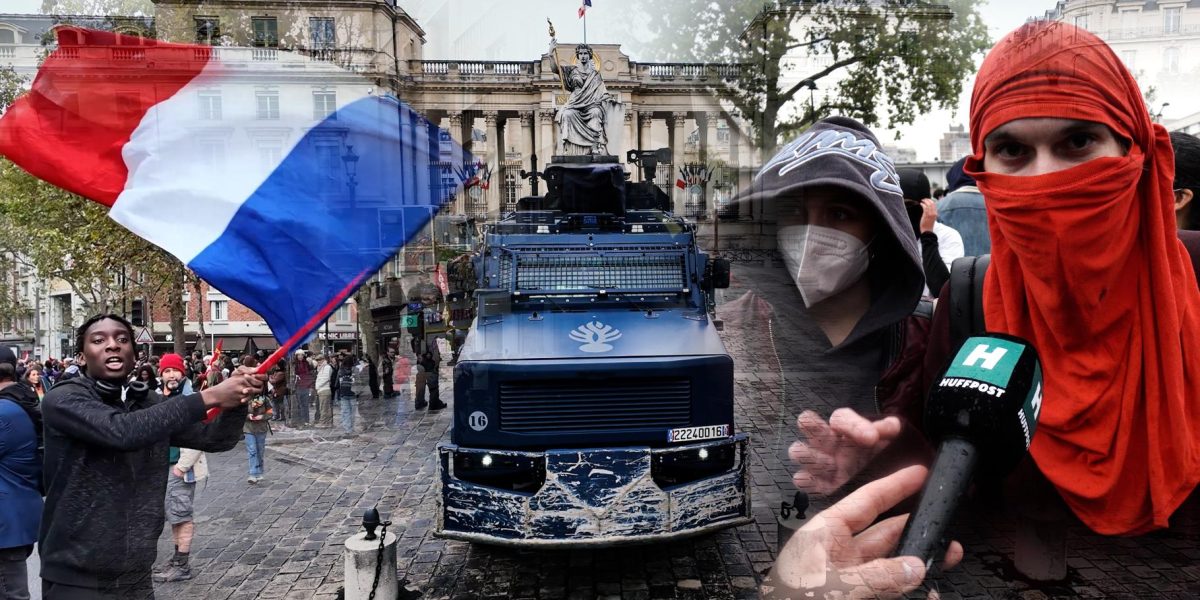
PARIS — A sprawling social movement that has shaken France for a month staged its second major day of mobilization on Saturday, October 24, drawing high school students, university students, workers, unions and yellow vest protesters into the streets of Paris and several other French cities.
The demonstrations came one week after the shock of the October 17 protests, which descended into violent clashes with security forces, looting and other damage. Interior Minister Laurent Nuñez had vowed to be “intransigent,” backed by an “extremely important” security apparatus.
70,000 Officers Deployed Across the Country
Some 70,000 police officers and gendarmes were deployed across the national territory to manage the various mobilizations, alongside armored vehicles, water cannons and helicopters, not to mention specialized units including the RAID, GIGN and BRI.
As seen in our video report, we followed this new day of demonstrations in the capital, where the imposing security deployment, numerous police checks and a last-minute change of protest location left the impression of an “invisibilization” of the “popular revolt.” Several demonstrators told our microphone they feared an “authoritarian turn,” citing also the growing number of protest bans.
Macron Vows to Ban Protests From ‘People With No Legitimacy’
Following a security council meeting on Thursday, October 22, President Emmanuel Macron declared that protest requests filed by “people who have no legitimacy” would be systematically banned. Requests submitted by unions, by contrast, could be examined and potentially authorized.
In total, the CGT union counted 800,000 demonstrators across the country on October 24 — the same figure as a week earlier — even as several protest bans remained in force, notably in Bordeaux, Lyon and Nantes. The Interior Ministry, for its part, counted 410,000 demonstrators.
Escalating Tensions and Growing Bans
The scale of the security response and the multiplying bans have become a central point of contention. Critics argue that the combination of mass deployments, heavy police checks and last-minute relocations serves to suppress rather than manage dissent.
- 70,000 police and gendarmes mobilized nationwide, plus armored vehicles, water cannons and helicopters
- Specialized units including RAID, GIGN and BRI deployed
- Protest bans enforced in Bordeaux, Lyon and Nantes
- CGT counts 800,000 demonstrators; Interior Ministry counts 410,000
- Demonstrators warn of an “authoritarian turn”
The movement’s diverse composition — spanning students, workers, unions and yellow vests — underscores the breadth of discontent, while the government’s hardening stance has turned the question of the right to protest into a flashpoint of its own.