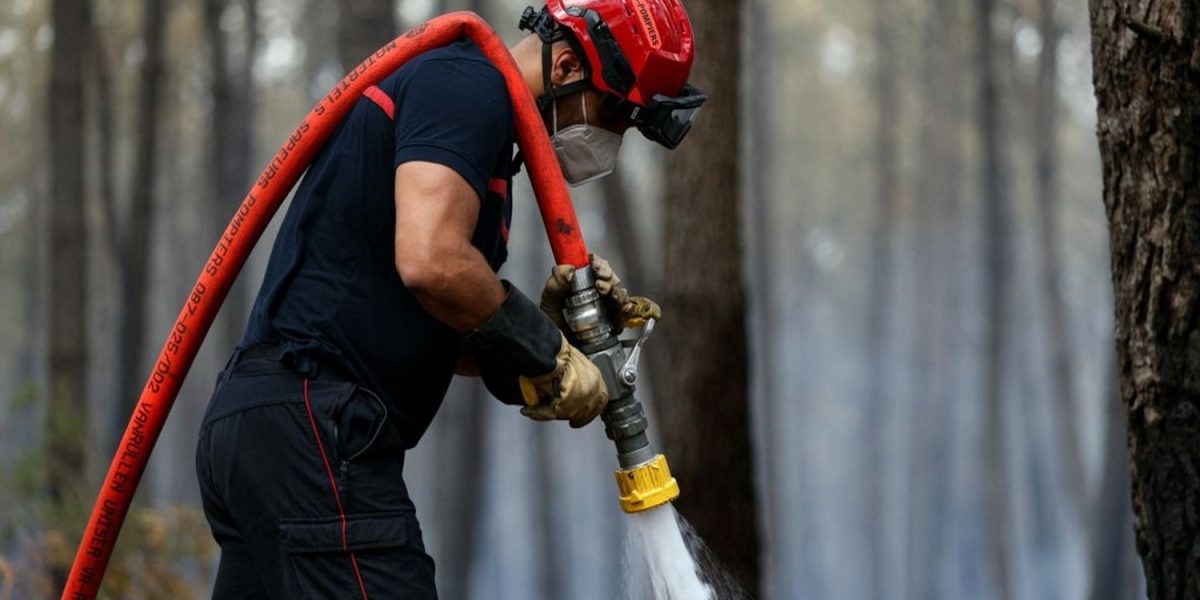
The images are searing: a wall of flames devouring pine forests, homes threatened, and exhausted firefighters battling an inferno that has already consumed 42,000 hectares in just eleven days. For many who watched the Gironde mega-fire unfold, the instinct was no longer to simply watch in horror, but to act. Across France, the catastrophic blazes have sparked a significant surge in people seeking to become volunteer firefighters, a move driven not by a thirst for heroism, but by a profound refusal to remain on the sidelines.
A Call to Action
Antoine, a 35-year-old history teacher originally from Saint-Médard-en-Jalles, saw the flames threaten his parents’ and friends’ homes. “I want to help,” he stated simply. The feeling of powerlessness was overwhelming. He had already considered joining the fire service after the devastating 2022 fires, but this year was different. Present on the ground, he and his friends found themselves filling agricultural water tanks without formal training or coordination—a frustrating experience that crystallized his decision. “I saw my little country, the region that saw me grow up, burn before my eyes,” he lamented. His application is nearly ready.
Antoine’s sentiment is echoed by dozens of others who responded to a call for witnesses from franceinfo. Bruno Ménard, secretary general of the National Union of Volunteer Firefighters (SSPVF), confirmed a remarkable spike in interest. A recent recruitment drive garnered nearly 10,000 responses nationwide in just 48 hours. “We haven’t seen such a resurgence of interest since Covid,” he noted, though he cautioned against an idealized view of the role. “You have to be aware that it’s not easy every day to be a volunteer firefighter.”
Concrete Action Over Eco-Anxiety
For Sophie, a 38-year-old project manager in the energy sector near Saint-Etienne, the videos of firefighters in action provided a strange sense of hope amidst the catastrophe. “Their actions give meaning, it gives hope,” she confided. For the first time, she is seriously researching the physical requirements and exploring whether other support roles might be a fit. Ménard emphasizes that the commitment extends far beyond fighting fires, with many missions not requiring direct intervention on the front line of a forest blaze.
In Bordeaux, Constance, an engineer working to reduce carbon footprints in the healthcare sector, had been contemplating associative work. The fires, raging just kilometers from her home, accelerated her thought process. “I want to move to concrete actions and be close to people,” she explained. Similarly, Caroline, a 38-year-old marine biodiversity specialist in La Rochelle, sees engagement as an antidote to eco-anxiety. Evacuated friends and the memory of the 2022 Arcachon basin fires solidified her resolve: “We must act. Even if these are small things, if they can be useful, that’s the main thing.”
Beware the ‘Hero Syndrome’
Antoine, despite his enthusiasm, is clear-eyed about his motivations. “I’m careful about the hero syndrome. I want to perform a civic action. I saw it in Lacanau, some people wanted to do too much. I was even part of that at the beginning,” he analyzed. His goal is not glory but civic duty.
This sense of service is a long-standing vocation for others. Guillaume, a 32-year-old father of two, previously spent two years with the American Red Cross, responding to hurricanes in Louisiana. Now a major risk prevention officer, he sees volunteering as a natural extension of his life’s philosophy. “I’ve always had the fiber of service… It’s important to question one’s place in society and what is possible to do at one’s own level,” he said.
For Augustin, a 32-year-old gendarmerie officer planning a career change, becoming a volunteer firefighter is a way to maintain a vital connection with the public. Having worked alongside firefighters on the 2022 Jura fires, he witnessed firsthand a “real lack of personnel.” His decision is a way to continue serving his fellow citizens when he returns to civilian life.
Beyond the Fire Service
The call to action extends beyond the traditional fire service. Adrien, an architect in his forties from Seine-Saint-Denis, is experiencing a deep professional crisis, feeling his work “does not sufficiently serve the good of people and society.” He has decided to forgo his holiday to Bilbao, Spain, to instead volunteer with civil protection organizations aiding victims in the South-West. “I don’t feel like going to enjoy myself while people are suffering… I prefer to help rather than go on vacation,” he explained, seeking to regain a feeling of being useful.
For all these individuals, the Gironde wildfires have been a catalyst. The path to becoming a volunteer firefighter requires dedication—applicants can be aged 16 to 67, often must live within eight minutes of a station, and commit to hundreds of hours of on-call duty per year, followed by formal training. Yet, for a growing number of citizens, the choice is clear: it is a move from passive concern to active citizenship, proving that in the face of disaster, the human impulse to help burns brighter than ever.