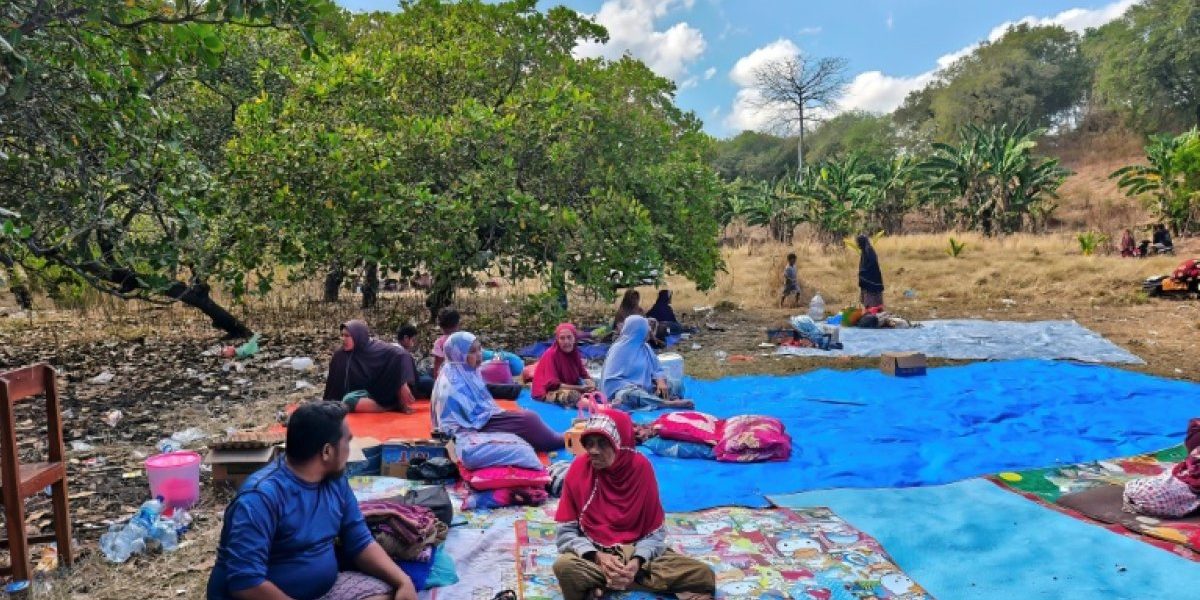
Thousands of displaced residents waited anxiously for assistance on Sunday following a powerful earthquake that struck the Indonesian island of Flores, leaving at least 51 people dead, dozens injured, and hundreds of buildings damaged.
Nearly 5,000 people were forced from their homes by the magnitude 7.7 tremor that hit Saturday morning, followed by 341 aftershocks, according to Berton Suar Pelita Panjaitan, a spokesperson for the national disaster management agency.
Some areas remain without electricity or telecommunications, and at least one emergency access road is still impassable, complicating relief efforts.
Survivors Describe Terror and Desperate Need
“We need food, something to drink, medicine, and diapers for the children,” Umri, 55, told AFP on Sunday. Like many Indonesians, he goes by a single name.
Umri, from Nangahale on Flores’s northern coast, said he waited 24 hours in the hills after the disaster, sharing the same elevated refuge as Nurhidayati, also 55.
“I am still terrified. My heart races when I think back to the shaking… We ran up here yesterday. I am really scared now. I am still traumatized by the 1992 earthquake. I don’t dare go home,” Nurhidayati said.
Flores was previously struck by a magnitude 7.7 earthquake in 1992 that triggered a tsunami and killed about 2,500 people.
“I hope the government will soon distribute supplies to help us,” she added.
Death Toll Rises as Damage Mounts
The National Search and Rescue Agency (Basarnas) announced Sunday that the death toll had risen to 51, with 132 people injured. No missing persons had been reported.
Survivors urgently need emergency tents, food, medicine, blankets, camp beds, floor mats, drinking water, and power generators, officials said.
According to Panjaitan, at least 101 Flores residents were wounded. “Beyond the lives lost, the offshore earthquake caused material damage that has paralyzed the daily activities of residents,” he said in a statement.
State of Emergency Being Prepared
Fathur Rahman, a local search and rescue operations chief, told AFP on Sunday that he was not aware of any victims buried under rubble or still missing.
The earthquake’s epicenter was just north of Flores, a tourist island in eastern Indonesia where buildings are generally low-rise.
Immediately after the tremor, residents rushed to higher ground after seeing the sea recede, a possible precursor to a tsunami. The alert was quickly lifted, but authorities urged people not to re-enter weakened structures that could collapse in aftershocks.
At least 914 homes were severely damaged, with hundreds more suffering lesser impacts. Dozens of public buildings were also affected: 93 educational facilities, 36 health facilities, and 38 government buildings.
The provincial government of East Nusa Tenggara, where Flores is located, is preparing a decree to place the region under a state of emergency for the next 14 days, Panjaitan said.
The Red Cross and Red Crescent said preparations were underway to deliver aid to thousands of displaced people in temporary shelters.
Humanitarian Response Underway
The Indonesian government has dispatched 50,000 kits totaling 275 tons of humanitarian aid. The European Union offered access to its Copernicus Earth observation satellites to assist with terrain reconnaissance and locating possible victims.
In Ruteng, a town about 200 kilometers from the hardest-hit area, AFP journalists saw heavy machinery clearing debris from streets on Sunday.
Yohana Raisita Damalia Mari, a spokesperson for the local hospital, said the building was severely damaged and patients had been evacuated to tents set up outside.
One woman underwent an emergency cesarean section in an intact storage room converted into a makeshift operating theater. “Thank God, the procedure went well and both the patient and her baby are out of danger,” Yohana said.
Indonesia sits on the Pacific “Ring of Fire,” an area of intense seismic activity. In 2004, a magnitude 9.1 earthquake off Sumatra triggered a devastating tsunami that killed 170,000 people in Indonesia and about 50,000 others in neighboring countries—one of the worst natural disasters ever recorded.