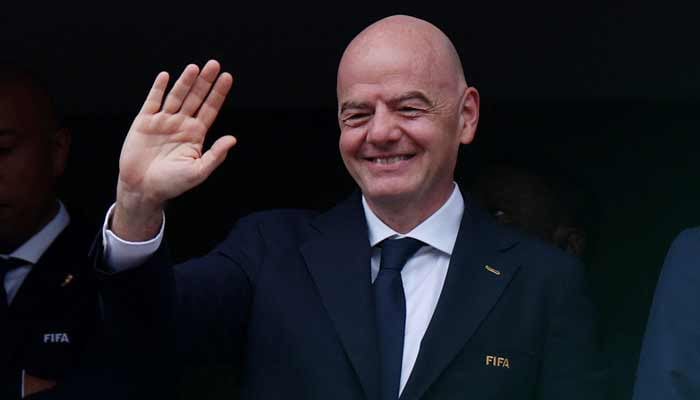
FIFA President Gianni Infantino has robustly defended the introduction of mandatory hydration breaks at the 2026 World Cup, pushing back against accusations that the controversial stoppages are designed to generate additional broadcast revenue.
The three-minute breaks, implemented in the 22nd and 67th minutes of every match, were introduced to help players cope with the extreme heat across North American host cities. However, they have become a lightning rod for criticism from managers, players, and fans who argue they disrupt the flow of the game and serve as new advertising windows for television networks.
“There is no additional revenue for FIFA, as all commercial agreements were signed well in advance. So, this is not a financial issue for us. For us, it is purely a sporting matter,” Infantino stated on Wednesday.
Coaches Voice Strong Opposition
The tactical implication of the breaks has sparked an intense debate within the sport. The stoppages provide coaching staff with a guaranteed in-game opportunity to deliver instructions, a shift that critics claim fundamentally alters the nature of football.
England manager Thomas Tuchel articulated the frustration of many purists, saying the additional break “interrupts and changes the identity of the football match.” Uruguay’s veteran coach Marcelo Bielsa went further, arguing that dividing matches into shorter segments strips away a fundamental characteristic of the game—its continuous flow.
While Spain coach Luis de la Fuente and Netherlands captain Virgil van Dijk have supported the rule’s intent in extreme heat, they questioned the necessity of enforcing it during cooler conditions or in air-conditioned indoor venues.
FIFA Cites Fairness and Player Welfare
Infantino countered the criticism by framing the policy as an issue of competitive equity and physical safety. He emphasized that in a grueling tournament spanning 39 days, where a team could play eight matches, moments of rest are critical.
“The main reason is the heat, but we also have to understand that a competition like the World Cup… having a moment to rest is extremely important,” he said.
He stressed that uniform application across all fixtures was non-negotiable to prevent competitive imbalance. “It’s very difficult to accept that a coach might have the opportunity to influence a match by making adjustments simply because it’s hotter, while in another match, where the temperature is slightly lower, the same coach doesn’t have the same opportunity,” Infantino explained.