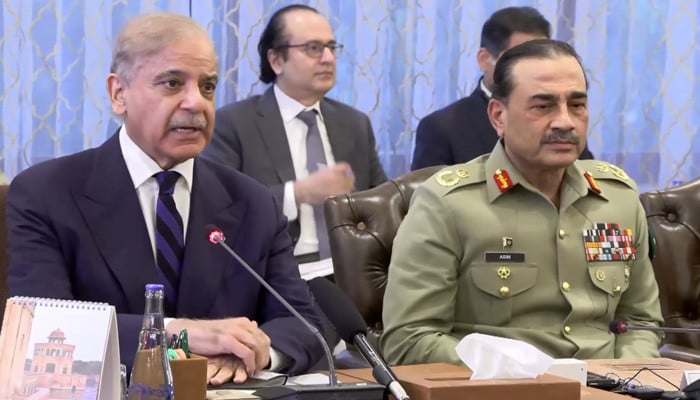
Prime Minister Shehbaz Sharif has definitively stated that Iran’s ballistic missile programme was excluded from the landmark memorandum of understanding (MoU) signed in Islamabad between Tehran and Washington. Speaking at a joint press conference with Iranian President Masoud Pezeshkian, the premier warned against “double standards” and “spoilers” seeking to undermine the fragile peace process aimed at ending the Middle East conflict.
No Missile Clause in the Agreement
During high-level delegation talks in Islamabad, PM Shehbaz addressed growing speculation about the scope of the agreement. He insisted that the issue of ballistic missiles was never on the negotiating table.
“There is no mention of ballistic missiles in the memorandum of understanding agreed between Iran and the United States because the issue was never part of those discussions,” the prime minister clarified. He argued that it was fundamentally unfair for some nations to possess such capabilities while questioning Iran’s sovereign right to do the same.
Warning Against Spoilers
The premier cautioned against attempts by external elements to misrepresent the contents of the MoU to sabotage the peace initiative. He urged observers to avoid confusion, stressing that in his capacity as a mediator, he could confirm the agreement contains no reference to Iran’s missile arsenal.
PM Shehbaz reaffirmed Islamabad’s unwavering commitment to its mediation role between Iran and the United States, vowing to continue efforts until a “lasting and honourable peace” is achieved. He praised the courage of the Iranian leadership and acknowledged the critical role played by Chief of Defence Forces Field Marshal Syed Asim Munir in securing the ceasefire and facilitating the deal.
Iranian President Backs Pakistan’s Stance
President Pezeshkian, on his first foreign visit since US-Israeli strikes on Iran in February, echoed the prime minister’s remarks with firm language. “Iran’s missiles were not in the MoU signed with the US and will never be,” he declared. He emphasized that Tehran would never negotiate its defence capabilities with any foreign power, insisting that regional stability can only be achieved through honest dialogue and intra-regional cooperation.
The Iranian leader described the relationship between the two neighbors as unique, founded on deep historical, cultural, and religious ties. He said the signing of the Islamabad MoU reflected Iran’s complete confidence in Pakistan’s mediation efforts.
A Symbolic Arrival and Diplomatic Engagements
President Pezeshkian’s aircraft, symbolically named “Minab 168” in tribute to the children martyred in a US-Israeli attack on a school in Iran’s Minab city, touched down to a red-carpet welcome. He was received by PM Shehbaz, President Asif Ali Zardari, and senior military leadership before holding productive meetings on bilateral relations and regional developments.
The visit followed the announcement of a 60-day roadmap towards a final US-Iran agreement, brokered with the assistance of Pakistan and Qatar during talks in Switzerland. PM Shehbaz expressed gratitude to friendly nations including Qatar, Saudi Arabia, Turkiye, and Egypt for their support, warning that failure to secure peace could engulf the region in a devastating wider conflict.
The Iranian president departed for Tehran on Tuesday night, seen off by Field Marshal Munir and Deputy Prime Minister Ishaq Dar.