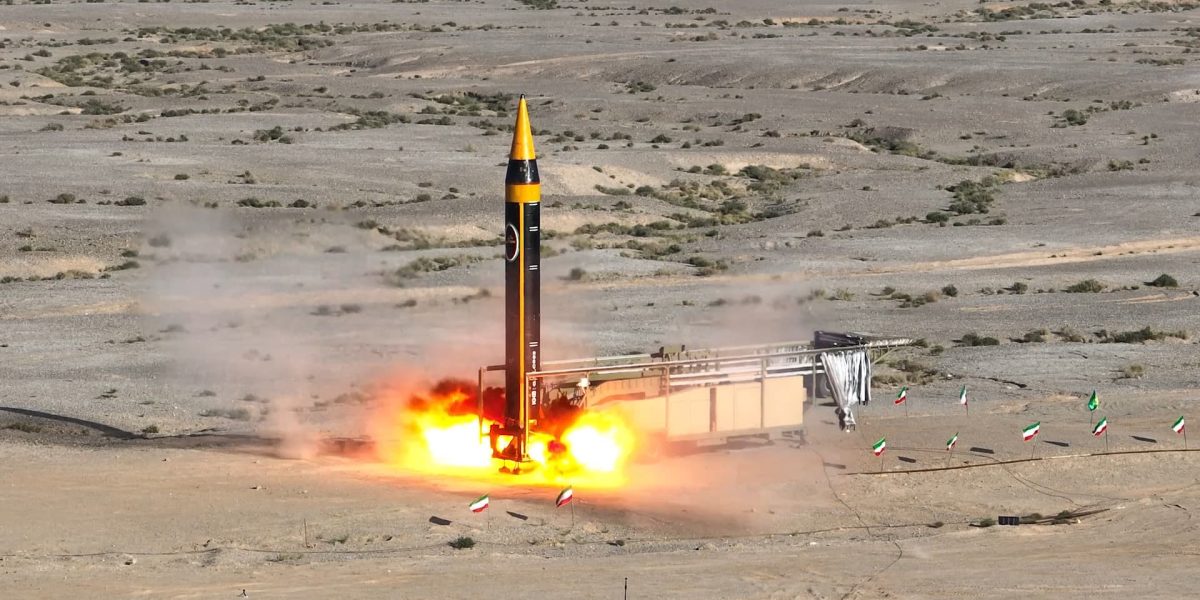
Iranian state television broadcast footage on Thursday of a new operational ballistic missile, the Khorramshahr 4, which it claims can reach speeds of Mach 16 and strike targets in Israel within 12 minutes. The broadcast marks a significant escalation in Tehran’s military posture and regional tensions.
Unprecedented Speed and Range
According to the state media report, the missile is a high-mobility tactical weapon. Its speed can reach Mach 8 (approximately 10,000 km/h) within the atmosphere and double to Mach 16 outside of it. The missile has an estimated range of 2,000 kilometers and can carry a warhead weighing over 1,500 kilograms.
The presentation of the missile, also referred to as “Kheibar,” is laden with symbolism. Its name references the ancient city of Khaybar in modern-day Saudi Arabia, the site of a 7th-century battle where the army of the Prophet Muhammad defeated Jewish inhabitants. During its initial unveiling in spring 2023, the missile was displayed next to a replica of the Al-Aqsa Mosque in Jerusalem’s Old City.
Context of Escalating Tensions
The revelation occurs amid heightened regional instability. The initial unveiling in 2023 followed a ceasefire in Gaza that ended a brief conflict between Israel and the Iran-backed Islamic Jihad. The development is part of a longer pattern of nuclear and military escalation by Iran following the collapse of the 2015 nuclear deal.
That agreement, formally known as the Joint Comprehensive Plan of Action (JCPOA), has been in crisis since the United States unilaterally withdrew under President Donald Trump in 2018. Iran has since progressively abandoned its commitments under the accord.
International Condemnation and Warnings
The international community has repeatedly condemned Iran’s ballistic missile program. Following a previous missile presentation, a French foreign ministry spokesperson stated that Iran was engaged in an “extremely worrying nuclear escalation.” France condemned the tests as a violation of United Nations Security Council Resolution 2231, which endorsed the 2015 nuclear deal.
Historical context underscores the persistent tensions. Shortly after the first Khorramshahr missile was inaugurated in 2017, then-President Donald Trump issued a stern warning to Tehran, casting doubt on the survival of the newly signed nuclear agreement.
The demonstration of the Khorramshahr 4 represents a clear advancement in Iran’s missile technology, directly challenging regional security architectures and international non-proliferation efforts.