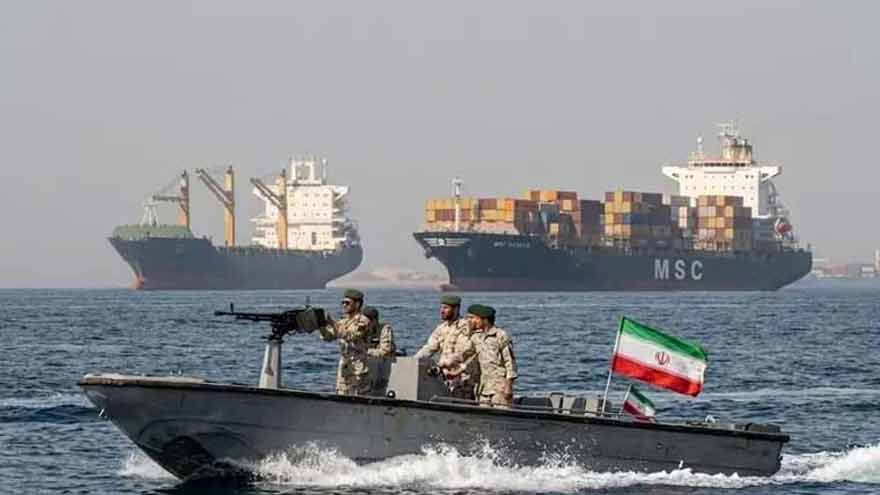
Iran’s Islamic Revolutionary Guard Corps has issued a direct warning to the United States, threatening to strike American military installations across the Middle East if Washington continues providing security escorts to vessels passing through the Strait of Hormuz.
In a statement carried by media reports, the IRGC described continued US military protection for ships in the strategic waterway as unlawful and said such operations could invite retaliation against American bases throughout the region. The force framed the escort missions as a violation of Iranian regulations governing the strait.
Naval Force Claims Four Vessels Set Ablaze
Alongside its warning to Washington, the IRGC claimed its naval units simultaneously struck four vessels involved in oil transfers in the Gulf, setting them on fire. No independent confirmation of the strikes was immediately available, and details on casualties or the vessels’ ownership were not disclosed.
The Strait of Hormuz is among the world’s most critical energy corridors. Before the current conflict, roughly one-fifth of global oil supplies passed through the narrow waterway connecting the Gulf to open oceans, making it a perennial flashpoint for international shipping disputes.
Waterway Shut Since March
According to the report, Iran has kept the strait closed since March in response to US and Israeli attacks, a move that has heightened concerns over regional security and the stability of global energy supplies. The closure has forced shippers to consider lengthy and costly alternative routes.
- The IRGC warns US escort operations in the Strait of Hormuz could trigger attacks on American bases in the region.
- Iranian naval forces claim to have set four oil-transfer vessels ablaze in the Gulf.
- Tehran has kept the strait closed since March, citing US and Israeli attacks.
- The waterway previously carried about one-fifth of global oil supplies.
The latest escalation underscores the fragility of maritime security in the Gulf, where military and commercial traffic share some of the world’s most congested and contested waters. Any widening of the confrontation between US forces and the IRGC risks disrupting energy flows and drawing in regional actors.