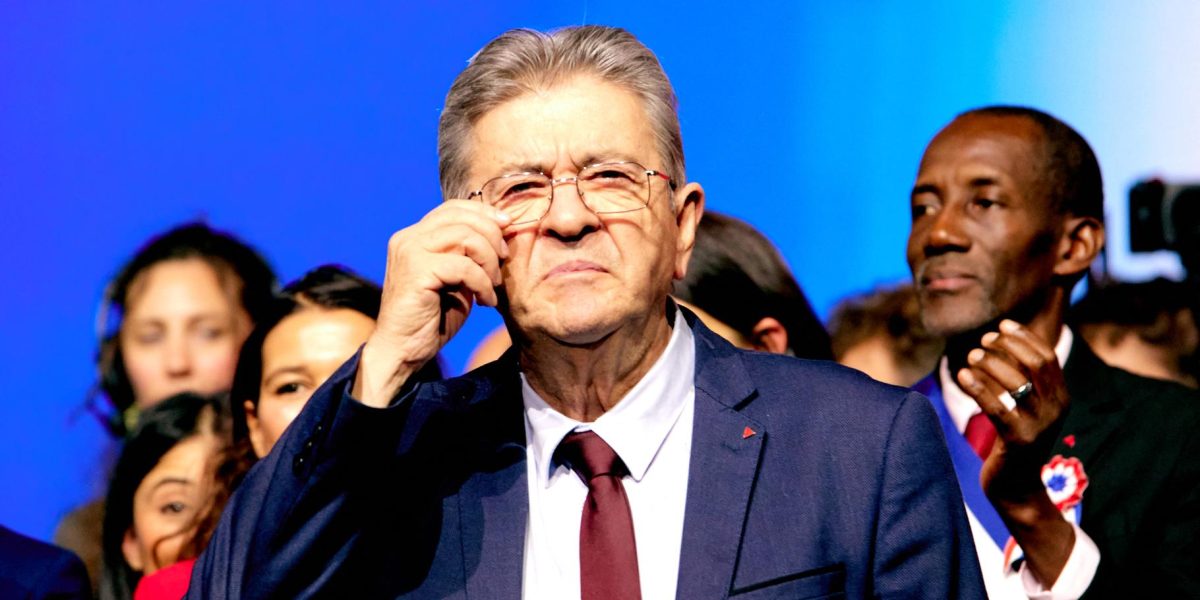
Jean-Luc Mélenchon has long confounded his critics with a foreign policy worldview that many regard as out of step with geopolitical reality. The leader of La France Insoumise (LFI) has consistently framed his positions under the banner of “peace” — a posture he is expected to invoke once again this Wednesday, having chosen the pacifist memorial at Gentioux-Pigerolles in the Creuse department to mark the November 11 armistice commemorations.
And once controversy erupts, the choreography is familiar: Mélenchon insists his detractors have deliberately misread him — whether out of unrestrained Atlanticism, incompetence, or both. His recent remarks on the Donbass, delivered during a rally in Le Bourget on Saturday, November 7, offer yet another illustration of this pattern.
A Remark That Echoed Moscow
In a speech defending his refusal to soften the radicalism of his program, Mélenchon addressed the war in Ukraine, arguing that one must consider the “rights of the population of the Donbass, who have the right to know whether they want to be Ukrainian or Russian.” The statement was swiftly interpreted as aligned with Vladimir Putin’s propaganda, which routinely invokes the right of (Russian-speaking) Donbass populations to return to their “historic homeland” — despite a 1991 referendum that settled the question.
Kyiv Pushes Back, Mélenchon Counterattacks
Ukraine’s foreign ministry directly rebuked the LFI candidate, reminding him that local referendums organized in illegally occupied territories are nothing more than an “instrument of annexation” serving the aggressor. Taken to task — including by French diplomacy — Mélenchon did what he does best in such situations: he counterattacked.
According to Mélenchon, he had merely restated the framework of talks between Kyiv, Washington, and Europe, during which Volodymyr Zelensky himself reportedly expressed openness to territorial concessions in the east — on condition they be ratified by referendum.
But the point does not hold. Zelensky never proposed a referendum exclusively for “the population of the Donbass,” but for the entire Ukrainian people, as stipulated by Article 73 of Ukraine’s Constitution. He also conditioned any such vote on a ceasefire of at least six months. None of this deterred Mélenchon, who framed the factual correction as persecution by the “media establishment.” He even suggested that scrutiny of his analytical shortcomings stemmed from an “instruction issued from outside newsrooms” — as though this journalist had received a call from the Quai d’Orsay or the CIA to examine his international worldview.
A Pattern of Statements Minimizing Russian Responsibility
More troublingly, Mélenchon’s indignant response ignores that his Donbass remark fits within a continuum of positions that downplay Russia’s responsibility for the nightmare endured by Ukrainians and the threats posed by Putin’s imperialism. In a recent extended interview with François Lenglet, the LFI leader answered in the negative when asked whether he considered Russia an enemy — despite hostile acts on French and European soil attributed to Moscow by intelligence services. Similarly, in August 2025, he questioned the legitimacy of the Ukrainian president.
Such declarations are accompanied by campaign promises seemingly tailor-made to please the Kremlin, including France’s withdrawal from NATO. This coherent — if contested — worldview consistently works against the candidate whenever he addresses international affairs.
French Voters Reject Compromise with Moscow
The question now is whether this becomes a genuine handicap in his quest for the Élysée. The first problem is that it exposes him to broadsides from adversaries across the political spectrum, including the left. Raphaël Glucksmann, deeply engaged in international issues, has accused Mélenchon of reciting “talking points supplied by the Kremlin for years and years.” This refrain will resurface every time the candidate is asked to position himself on Russia — potentially undermining his ability to build coalitions beyond his core support.
Polling suggests left-wing voters clearly back Ukraine. In a February 2026 Ifop survey, 59% of left-leaning sympathizers approved sending military equipment to Kyiv — a policy LFI lawmakers have vigorously opposed in the National Assembly. Notably, LFI supporters were the only left-wing group to oppose it by majority (50% disapproval versus 45% approval). This demonstrates that Mélenchon’s stance, confining him to his hard core, cuts him off from the social-democrat and green electorate he would need to win.
Beyond the left, French voters broadly reject compromise with Moscow. In a large-scale YouGov study across Europe, a peace treaty leaving Russia in control of Ukrainian territories was viewed very negatively by 58% of the French population. And for good reason: 68% of French respondents are convinced Russia would relaunch a war against Ukraine within ten years of such an agreement — a finding that measures the limits of Mélenchon’s self-described “pacifist” discourse.
The Paradox of the Reserved Domain
Still, the scale of this obstacle must be measured carefully. Traditionally, domestic issues vastly outweigh international considerations for voters. In a CEVIPOF study conducted in September, “defense issues (war in Ukraine and the Russian threat, multiplying conflicts…)” were cited as a priority by only 15% of French respondents — far behind economic concerns. In an era when political debate centers on the cost of living — an area where Mélenchon has substantial proposals — the impact of his international worldview on his electoral potential may be relative.
Yet paradoxically, a presidential election also demands a significant element of personification, as the people prepare to entrust a candidate with representing France on the world stage. This is the famed “reserved domain” of the head of state, now charged with intervening in the great affairs of the world. With this in mind, the danger is real for Mélenchon. For while international affairs have never won an election, an erratic — or seemingly outdated — approach to world events can contribute to defeat.