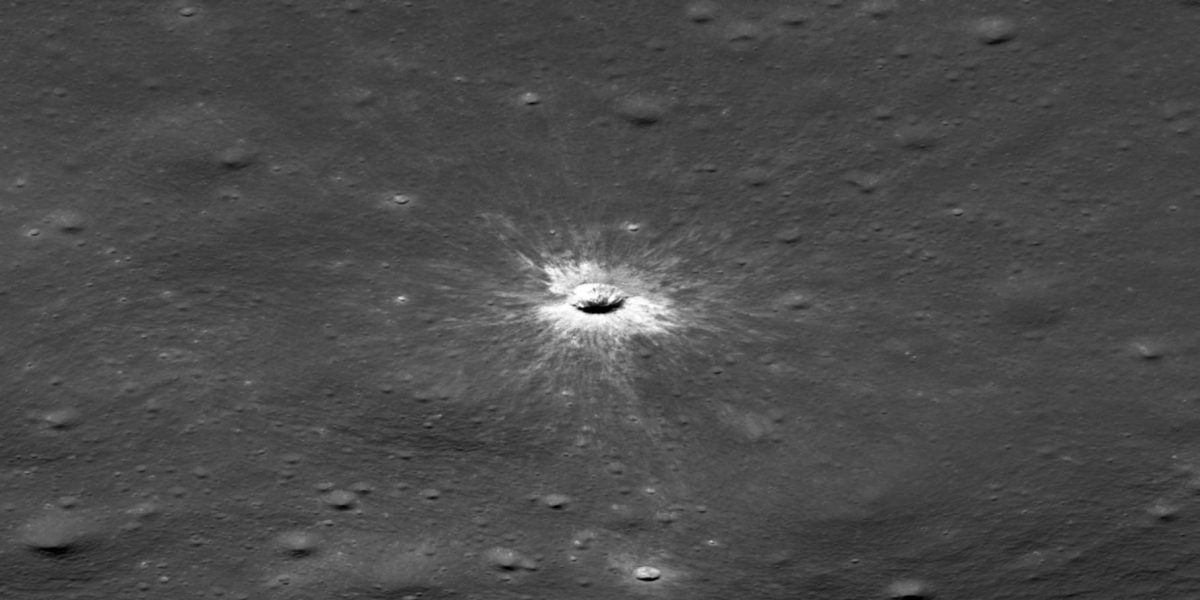
A American researcher has discovered a massive crater recently formed on the lunar surface using images from a NASA probe, an event scientists describe as occurring “only once per century.”
The crater, which initially went unnoticed, was spotted almost by chance by Robert Wagner, a researcher working with data from the Lunar Reconnaissance Orbiter Camera, a NASA probe that has been studying Earth’s satellite since 2009.
“I stopped everything I was doing and focused on this task,” the scientist explained on the space agency’s website.
A Crater Named McGetchin
Named “McGetchin” in honor of a renowned lunar geophysicist, the 222-meter-diameter crater was likely caused by the impact of a comet or asteroid on the lunar surface in spring 2024, according to NASA.
Appearing in images as a bright spot surrounded by a dark halo, it has proven to be the largest recently formed crater ever identified in the solar system, according to a study published Wednesday, September 17, in the journal Science Advances.
No Atmosphere to Protect the Moon
Unlike Earth, the Moon has virtually no atmosphere. Meteoroids, asteroids, and other space debris are therefore neither slowed down nor burned up before reaching the surface. According to researchers’ estimates, the new crater was likely caused by an object the size of a three-to-six-story building.
The smallest cavities observable by scientists’ equipment are the width of a three-story building lying on its side and are created by debris approximately 1.10 meters wide. According to NASA, this type of impact creates 140 new craters on the Moon each year.
Although Earth’s satellite hosts numerous craters, some much larger, the near-real-time observation of such a crater’s formation and monitoring of its evolution could help scientists better understand the complex geology of the celestial body. It could also help better prepare future manned missions, as the United States and China both aim to build bases on the lunar surface.
- The crater measures 222 meters in diameter
- It was formed by an object the size of a three-to-six-story building
- The discovery was published in Science Advances on September 17
- Approximately 140 new craters form on the Moon each year