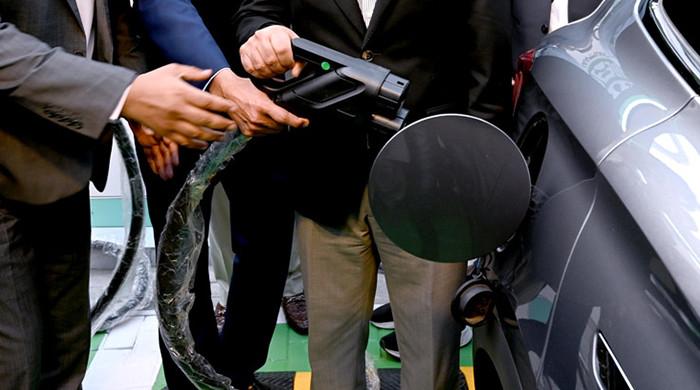
Pakistan’s oil industry is pushing back against government mandates requiring electric vehicle (EV) charging infrastructure at petroleum retail outlets, arguing the policy is commercially unviable given the country’s low EV adoption rate.
High Costs, Low Utilization
The Oil Companies Advisory Council (OCAC), representing oil marketing companies (OMCs), has formally requested the withdrawal of compulsory EV charger requirements linked to K-Form issuance and new station approvals. In a letter to Petroleum Minister Ali Pervez Malik, the council highlighted the stark economic reality: installing a single Level-3 fast charger requires an investment of Rs15-20 million, yet most existing stations operate at a loss due to minimal usage.
Currently, only about 3,000 electric vehicles operate nationwide—a far cry from the 125,000 targeted under the government’s New Energy Vehicles (NEV) policy. With just 15 charging stations established by OMCs so far, only a handful have reached operational breakeven.
Policy-Implementation Gap
The OCAC expressed support for the government’s cleaner energy vision but noted critical flaws in implementation. “OMCs, which are expected to implement EV charging infrastructure at retail outlets, were not involved during the policy formulation stage,” the council stated, revealing a significant stakeholder gap.
While a special electricity tariff of Rs38.9 per unit has been approved for EV charging, broader fiscal incentives and customs duty structures remain unresolved, with finalization expected in fiscal year 2026.
Structural Challenges
The industry identified multiple implementation barriers:
- Delays in obtaining no-objection certificates from local authorities
- Mandatory linkage between K-Form issuance and Level-3 charger installation
- Withheld approvals for new fuel station layouts lacking EV infrastructure
Furthermore, the council questioned the fundamental premise of locating chargers at petrol stations. “Global trends show EV charging is largely carried out at residential premises, commercial complexes, hospitals, parks and shopping malls,” the letter noted, contrasting this with petrol stations designed for quick turnover rather than extended charging sessions.
Call for Phased Approach
The OCAC advocates for a demand-driven, commercially sustainable framework developed in consultation with all stakeholders, including the Ministries of Climate Change and Energy, Ogra, and the National Energy Efficiency and Conservation Authority.
The council suggested that once a viable EV population emerges and enabling fiscal policies are established, OMCs would naturally expand charging infrastructure—similar to their experience with compressed natural gas adoption. Until then, mandatory requirements risk imposing unsustainable financial burdens on the industry during Pakistan’s early-stage EV transition.