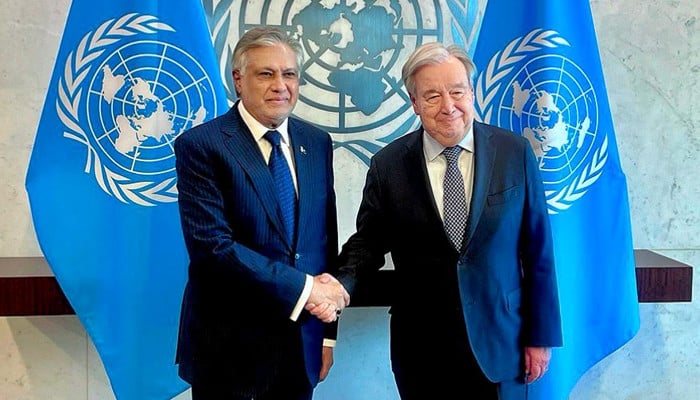
Deputy Prime Minister and Foreign Minister Ishaq Dar held urgent talks with United Nations Secretary-General Antonio Guterres in New York on Wednesday, as a fragile ceasefire painstakingly brokered by Pakistan faces severe strain from renewed US strikes on Tehran and heavy Israeli bombardment of Lebanon.
The high-stakes meeting occurred on the sidelines of a UN Security Council session, with the Foreign Office confirming that the two leaders exchanged views on the rapidly deteriorating situation in the Middle East and West Asia.
Mediation Breakthrough Under Threat
Iran accused the United States on Tuesday of violating the ceasefire by striking targets near the contested Strait of Hormuz. The military action complicates diplomatic efforts led by Islamabad to bring the conflict to a definitive close. Compounding the crisis, Lebanese security sources reported that Israel pounded Lebanon with more than 120 air strikes in one of the heaviest days of bombing in weeks. Iran has consistently demanded an end to Israeli attacks in Lebanon as a precondition for any lasting deal.
the meeting, Dar highlighted Pakistan’s successful hosting of the Islamabad Talks in April, describing the event as a significant diplomatic breakthrough. He noted that the ceasefire initially facilitated through Pakistan’s engagement continued to hold, but reaffirmed the necessity for sustained dialogue to achieve durable peace and stability.
Global Order at Risk
The deputy prime minister appreciated the secretary-general’s principled stance and support for Pakistan’s mediation efforts. Beyond the immediate crisis, Dar warned that a prolonged conflict in the Middle East could threaten the broader global order, emphasizing the need for robust multilateralism.
The discussions also spanned critical issues in South Asia. Dar expressed deep concern over what he termed provocative statements by the Indian leadership that undermine regional stability. He underscored that India’s decision to hold the Indus Waters Treaty in abeyance constituted a clear violation of international law.
Kashmir, Afghanistan, and Palestine
Reiterating Pakistan’s longstanding position, the foreign minister emphasized that the Jammu and Kashmir dispute remained core issue between the nuclear-armed neighbors. He stressed that its just resolution, in accordance with UN Security Council resolutions and the aspirations of the Kashmiri people, was essential for lasting peace in South Asia.
On Afghanistan, Dar expressed deep concern over the continued use of Afghan soil by terrorist groups against Pakistan. He reaffirmed Islamabad’s resolve to safeguard its national security in accordance with international law and the UN Charter.
Regarding Palestine, the deputy prime minister reaffirmed Pakistan’s unwavering support for the Palestinian people and their legitimate struggle for self-determination and statehood. He voiced appreciation for Guterres’ continued advocacy for a two-state solution and the implementation of the Gaza Peace Plan, as endorsed in Security Council Resolution 2803.
UN Reform and Peacekeeping
The meeting also touched on institutional reforms. Dar welcomed the secretary-general’s UN80 Initiative but emphasized that the interests and priorities of developing countries must remain central to the reform agenda. He pushed for a comprehensive Security Council reform process based on sovereign equality, transparency, and broad-based consensus, arguing that these principles could only be upheld through the addition of elected members.
Secretary-General Guterres appreciated Pakistan’s active engagement at the United Nations and its continued contributions to international peace and security, including through diplomacy and UN peacekeeping efforts.