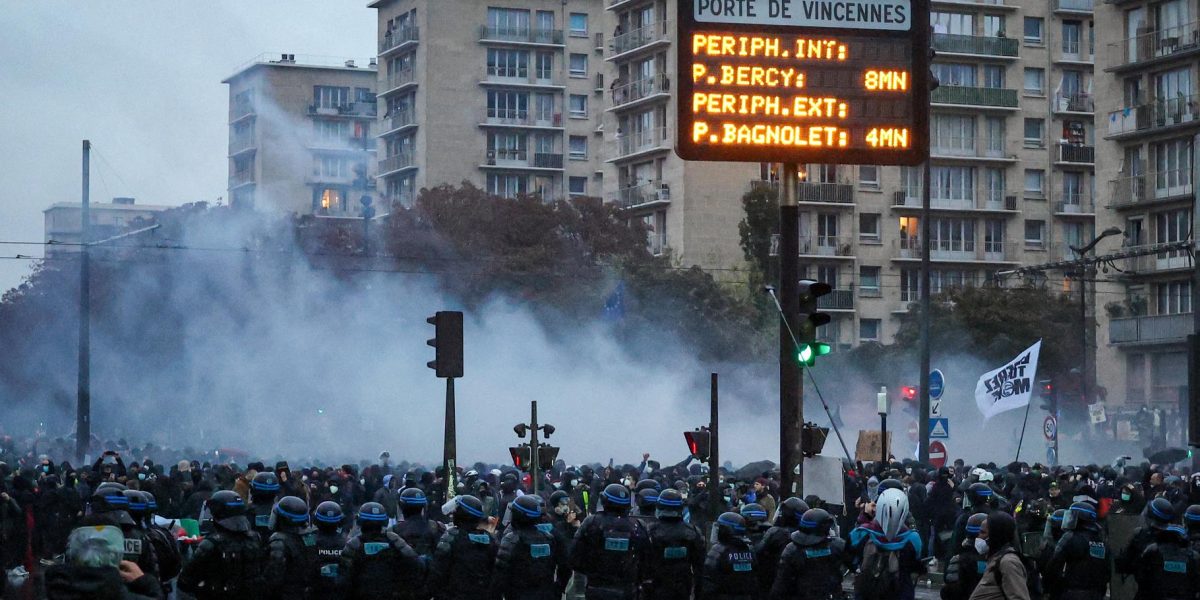
The Paris police prefecture has formally published a decree barring the march routes requested by unions and Yellow Vest protesters for Saturday, October 31, setting the stage for an emergency court battle over the right to demonstrate in the capital.
The order, issued late Friday morning, blocks the CGT union’s planned route from Place de la Bastille to Place de la Nation, as well as the Yellow Vests’ proposed path from Bastille to Place de la Concorde. The publication of the decree now allows the unions to challenge it in court.
Unions Had Threatened Legal Action Over Delayed Publication
On Thursday, seven employee and student organizations — including the CGT, FO, FSU, Solidaires, Fage, the Union étudiante and Unef — had filed an urgent application with the administrative court, demanding that any decree restricting the demonstration be published “as soon as possible” so it could be contested before Saturday.
The previous day, the organizations said authorities had verbally notified them of the ban and proposed relocating the march to a route running from Porte de Bagnolet to Porte de Charenton on the edge of the city. Paris police prefect Patrice Faure defended the alternative in an interview published Thursday evening, saying the route “avoids the city center, avoids damage and gives demonstrators great visibility.”
Student Groups Vow to March Despite Ban
Fage president Suzanne Nijdam said the organizations would take immediate legal action. “We are going to court today; emergency applications are being filed right now to challenge this decision, which in our view endangers safety,” she said, adding that the groups would decide jointly on how to respond to the imposed route.
“It is very important for us to remain united at a time when things are becoming very serious,” she said.
Speaking at a press conference, Unef treasurer Clara Privé accused the prefecture of “moving us from route to route, following incomprehensible hierarchical orders to forbid us from demonstrating in the city center.” She said the authorities were trying to “gag the voice of young people” and announced the group intended to “march from Bastille to Nation” despite the ban.
A representative of the Union étudiante condemned what he called “an unbearable administrative repression,” warning: “We will keep taking to the streets whatever their schemes and maneuvers, and we will be out in force this Saturday and on November 5.”
Organizers Feared a Procedural Trap
The Île-de-France inter-union coalition had worried that authorities would publish the decree too late for it to be challenged in court. “We refuse to fall into the trap,” organizers said in a statement. Last week, the unions were already forced to accept a route along the edge of Paris, between Porte d’Italie and Porte de Vincennes.
The emergency application seen by AFP asked that any decree concerning Saturday’s demonstration be published “no later than 24 hours before it begins, and at the latest by Friday, October 30 at noon — the only measure allowing effective access to the emergency judge.”
According to the decree, the usual route through the center of the capital — linking Place de la République, Bastille and Nation — cannot be reinstated “for the time being” because “the conditions are not met,” citing security concerns linked to the risk of attacks and the need to allow businesses “to carry out their commercial activity.” The order also requires that the separate routes filed by the CGT and the Yellow Vests “converge” into a single gathering.