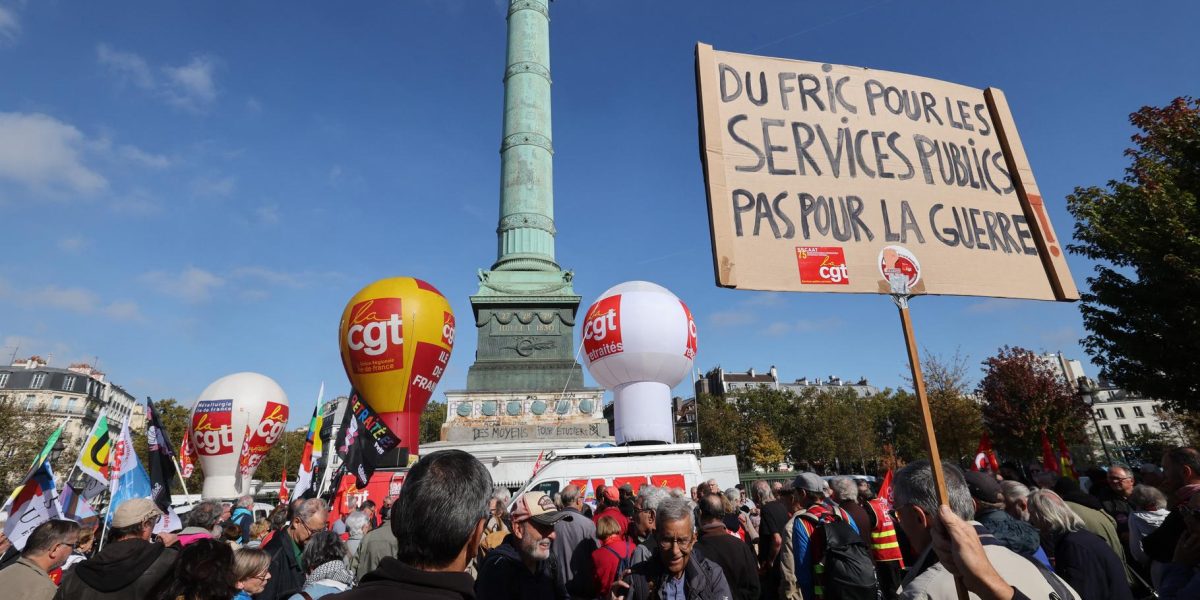
The Paris police prefecture banned the negotiated route of Saturday’s demonstration between Place de la Bastille and Place de la Nation, forcing organizers into a last-minute scramble that ended with the intersyndicale accepting an alternative itinerary along the city’s edge.
Prefecture Cites Risk of Public Disorder
According to the arrêté published Friday evening, the route negotiated with representatives of the CGT’s Paris departmental union was declared prohibited. The prefecture argued that the declared route presented “serious risks of public order disturbances, notably due to the high density of shops similar to those targeted during the weekend of October 17 and 18.”
The decree instead authorized the demonstration to take place from 1 p.m. to 7 p.m. from Porte d’Italie to Porte de Vincennes via the boulevards des Maréchaux, along the capital’s periphery.
Organizers Initially Reject ‘Impossible’ Route
The Île-de-France intersyndicale organizing the demonstration—comprising the regional branches of the CGT, CFDT, FO, FSU and Solidaires, along with major youth organizations including Fage, Union étudiante, Unef and USL—initially rejected the prefecture’s request as “unacceptable.”
Karl Ghazi, co-secretary general of the Paris CGT, told AFP the proposed itinerary was “impossible to secure.” He later indicated that the CGT had “challenged the arrêté before the administrative court,” a move confirmed by the student organization Fage.
By Saturday, organizers ultimately accepted the prefecture-imposed route. Thomas Vacheron, confederal secretary of the CGT, announced on BFMTV on behalf of the intersyndicale that “we will go to Porte d’Italie this afternoon,” with a departure scheduled for 2 p.m., calling on everyone to join the demonstration along the authorized route.
Merchants Caught Off Guard
Along the newly designated route, shopkeepers were reportedly taken completely by surprise and scrambled to barricade their premises in anticipation of possible vandalism and looting.
Unions Denounce ‘Last-Minute Reversal’
The Bastille-Nation route had been agreed upon Thursday “after two long meetings devoted to securing the procession and the conditions necessary for a peaceful demonstration,” the organizations emphasized. They condemned a “last-minute reversal” by the prefecture that “weakens the security conditions of the demonstration.”
“The entire intersyndicale agrees that we will not endorse a route that is dangerous for the safety of demonstrators,” said Suzanne Nijdam, president of the student organization Fage. “We have been working for a week on securing a route precisely to ensure everything goes as smoothly as possible this Saturday, so asking for a change at the last minute like this is very disrespectful to us.”
On Thursday, the police prefecture had already banned another route organized by the Interfac student collective and yellow vest protesters between Bastille and Opéra.
Left-Wing Leaders Voice Alarm
Left-wing leaders unanimously condemned the late route change, interpreting it as a means to “disrupt the organization of processions” and “sow confusion and therefore panic.”
“I am very worried about Saturday’s demonstration,” Marine Tondelier, leader of the Ecologists, wrote on X. “Obviously there will be people at Bastille, a meeting point we have all communicated about very widely. Will this gathering be treated by law enforcement as a wild assembly? That is very problematic and dangerous given the lessons of last weekend.”
“Once again, the authorities are playing at disorganizing processions and creating untenable deadlines for organizations to reorganize. These methods are multiplying across the country,” lamented Jean-Luc Mélenchon of La France Insoumise on X.
Olivier Faure, first secretary of the Socialist Party, expressed outrage at the “predictable result”: “two demonstrations, one of them with young people unaware of the change, who will go to Bastille for a demonstration that has become banned. How can anyone be more disorganized, ultimately endangering our children and reviving the risks of chaos?”
Communist leader Fabien Roussel argued that changing the route amounted to “disorganizing processions and sowing confusion and therefore panic.” He added: “And tomorrow, will they lecture demonstrators? The authorities must guarantee the right to demonstrate, not complicate its exercise.”