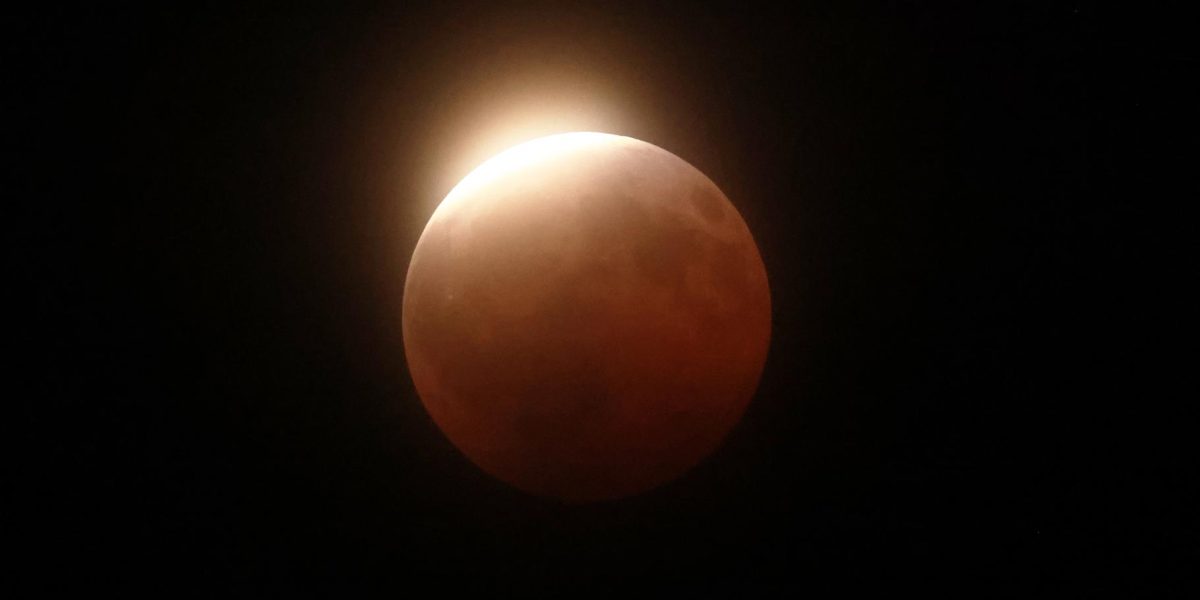
While much of France spent the night battered by violent thunderstorms and heavy rainfall, a select few in the southwest were treated to a spectacular celestial show: a partial lunar eclipse. The phenomenon, which peaked early Friday morning, turned a portion of the moon a striking reddish hue.
Why the Moon Turned Red
Unlike the total solar eclipse that captivated observers on August 12, this event involved a different alignment. A lunar eclipse occurs when the Earth positions itself directly between the Sun and the Moon, requiring the Moon to be in its full phase. As the Moon slips into the Earth’s shadow, direct sunlight is blocked from reaching part of its surface.
However, some sunlight still manages to reach the Moon by filtering through the Earth’s atmosphere. This refracted light is what gives the eclipsed portion its characteristic reddish glow, often referred to as a “blood moon.”
Peak Viewing and French Visibility
According to the Paris Observatory, the eclipse reached its maximum at 6:12 a.m. local time. The event was classified as “partial,” with 96% of the Moon passing into the Earth’s umbral shadow. Despite the high percentage, the Moon never fully entered the shadow cone, preventing a total eclipse.
For skywatchers in France, the spectacle was largely a matter of geography and luck. Weather maps published ahead of the event showed that only the southwestern part of the country had a reasonable chance of clear skies. Most other regions were obscured by the same storm system that brought heavy rain and thunder.
Stunning Images from Around the Globe
In contrast, observers in the United States and Latin America enjoyed much clearer views. Social media platforms were flooded with sharp, vivid images of the eclipsed Moon, showcasing the deep red tones against the night sky. These photos highlighted the stark difference in weather conditions across the Atlantic.
For those who missed the event in France, the wait for the next opportunity will be considerable. The Paris Observatory calculates that the next lunar eclipse visible from metropolitan France will not occur until January 12, 2028.