Pope Leo XIV departed for Rome on Monday evening, bringing an end to a four-day apostolic journey through France that culminated in a politically significant final day in the eastern city of Metz, where the pontiff appealed for peace on European soil and urged leaders to pursue dialogue over confrontation.
A Final Day Steeped in Symbolism
The American-born pontiff’s last day in France began with an interreligious gathering at the Robert-Schuman Convention Centre in Metz, where he met with leaders representing the country’s principal faith communities. Among those present were Cardinal Jean-Marc Aveline for Catholics, Pastor Christian Krieger for Protestants, Grand Rabbi Haïm Korsia for the Jewish community, Chems-Eddine Hafiz, rector of the Grand Mosque of Paris, for Muslims, Metropolitan Dimitrios Ploumis for Orthodox Christians, and Antony Boussemart for Buddhists. A joint declaration was signed at the conclusion of the exchange.
Following the meeting, the pope toured the streets of Metz aboard his popemobile before celebrating his final Mass in France at the city’s cathedral. According to the Vatican, approximately 35,000 faithful gathered inside the cathedral and in its surrounding areas. More than 60,000 people in total had been expected in the Moselle city, with many travelling from neighbouring countries to attend.
Pope Laments Return of War to Europe
During an address on European construction and peace delivered in the presence of several heads of state, including French President Emmanuel Macron, Pope Leo XIV expressed sorrow over the resurgence of war on the European continent and called on leaders to “show courage in negotiation.”
The pontiff also warned against deception in international relations, urging Europe to combat “lies and deceit” in diplomatic affairs.
President Macron, speaking at the same event, called on Europe to rediscover the “courage of its founding fathers” and to resist “withdrawal” and “the return of nationalisms.”
Homage to Chagall’s Genius
During the Mass at Metz Cathedral, the pope paid tribute to the stained-glass windows created by Marc Chagall, describing them as the work of a “genius.” He noted that the works of the Jewish painter, embedded within the cathedral’s walls, transform the house of worship into “an extraordinary symbol of ecumenism and interreligious dialogue.”
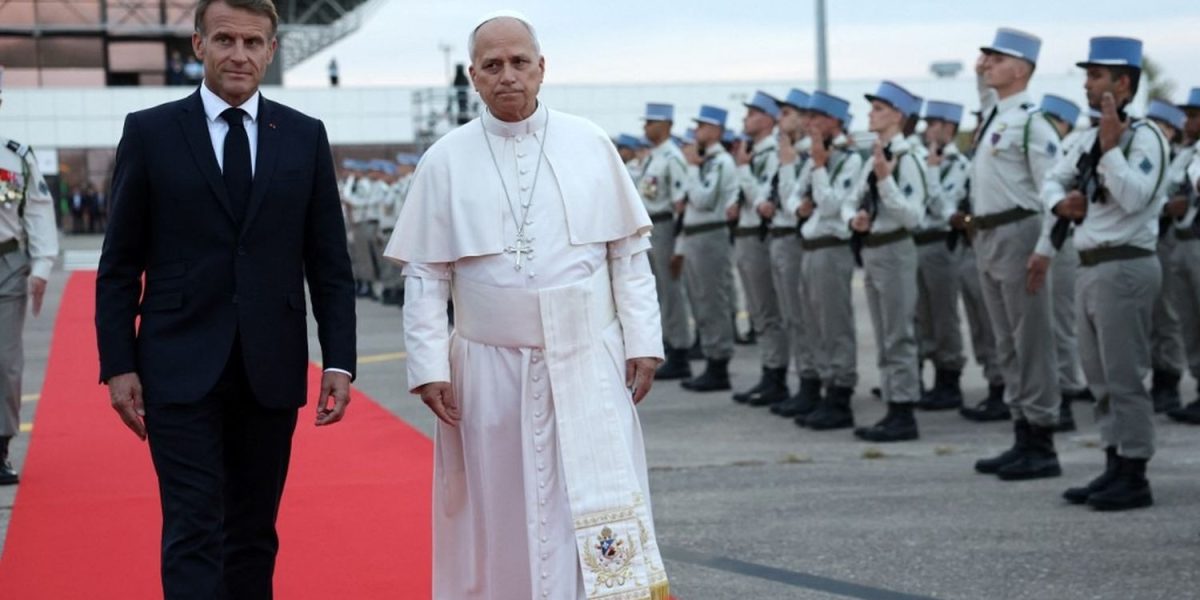
Following the service, the pontiff greeted faithful gathered outside the building before travelling to Metz-Nancy-Lorraine airport, where he was escorted across the tarmac and boarded his flight to Rome at approximately 7:30 p.m.
Macron Expresses Gratitude
In a message posted on X after the pope’s departure, President Macron thanked the pontiff for his visit. “You did not merely travel through France: you went to meet it,” he wrote. “France salutes you with gratitude and will long carry within it the echo of your passage, this hope that you came to share.”
The departure ceremony, known as the congedo, marked the official conclusion of the apostolic journey, with the pope accompanied by Emmanuel and Brigitte Macron before boarding his aircraft.
Four Days of Intense Engagement
The Metz visit capped an intense four-day tour that combined spiritual observance with pointed political messaging. The pope’s final address in France carried distinctly political undertones, as he advocated for peace and interreligious dialogue while urging European nations to reject falsehood in their international dealings.
Pope Leo XIV’s departure brings to a close a visit that drew tens of thousands of pilgrims and placed questions of European unity, peace, and interfaith cooperation at the centre of public discourse in France.