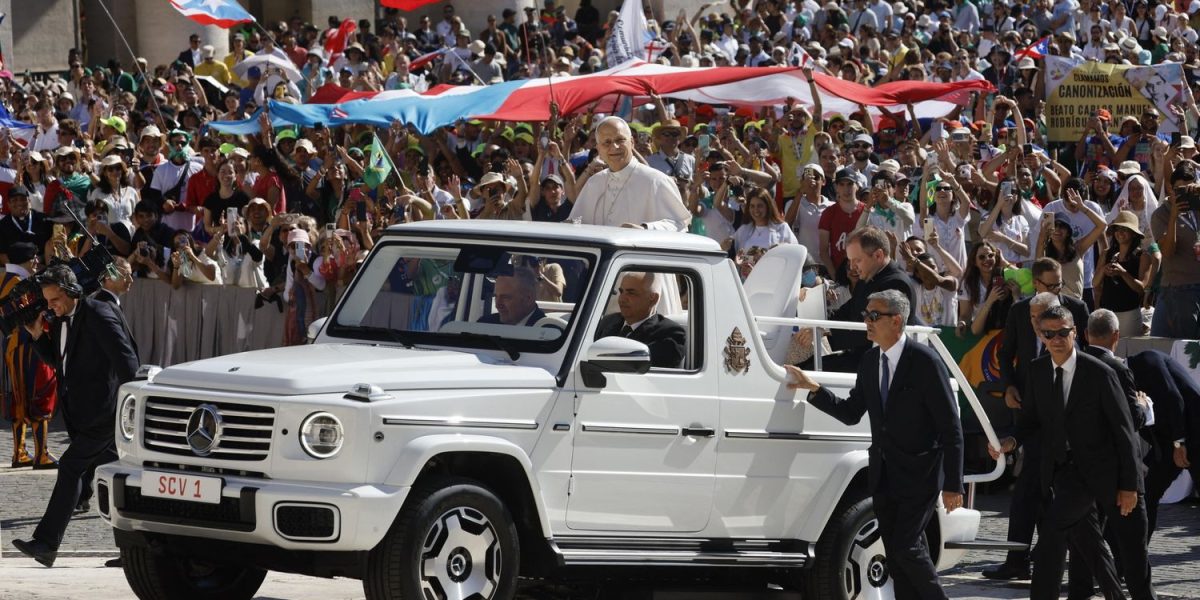
It is one of the most recognizable symbols of the papacy. In Paris, Saint-Denis, Lourdes and Metz, hundreds of thousands of people are awaiting the arrival of Pope Leo XIV in France. From a visit to the Élysée Palace and UNESCO to vespers at Notre-Dame-de-Paris, a mass on the Champs-Élysées and a vigil at the Stade de France, one of the highlights of the apostolic journey will be the pope’s processions aboard the famous popemobile in Paris and Metz — the emblematic vehicle of the sovereign pontiff, leader of some 1.4 billion Catholics worldwide.
This one-of-a-kind machine, whose name is a contraction of “pope” and “automobile,” will be at the center of attention. It is impossible to miss: with its white bodywork and raised seat at the rear, it allows the head of the Catholic Church to be seen by all the faithful. But how much do you really know about the history of this extraordinary vehicle?
A Symbol of the Church’s Modernization
The first popemobiles date back to 1930. That year, two manufacturers offered Pope Pius XI a car specially designed for his travels: André Citroën built a Lictoria C6, a luxury car equipped with a throne, while Mercedes-Benz donated a 60 Nürburg limousine to the Vatican, also fitted with a brocade seat at the rear.
However, popemobiles remained rarely used in the early 20th century. Until the 1970s, during crowd events, Catholic leaders were carried on a large throne known as the “sedia gestatoria” — literally a “carrying chair” — lifted by men on their shoulders so the faithful could see them. It was under Paul VI that habits began to change. The image of the throne, considered too distant from the people, was quickly abandoned. Modernizing the image of the papacy was also a priority. From then on, popemobiles were increasingly used for the travels of the sovereign pontiffs.
A Myriad of Manufacturers
Many brands have shaped the history of the Vatican’s vehicle fleet. The publicity value for a carmaker when the pope rides in one of its vehicles is enormous. The first popemobile of the modern era dates to 1976: a Toyota Land Cruiser 4×4, white inside and out and equipped with a platform allowing the Holy Father to be elevated. Then, in 1980, Italian brand Fiat provided John Paul II with a Campagnola. It was aboard this model that the pope became the target of an assassination attempt during a crowd event in St. Peter’s Square in May 1981.
Armored vehicles then became the norm, with iconic brands such as Land Rover and, above all, Mercedes-Benz. The German manufacturer is among those that have supplied the most vehicles to the Vatican. However, when a sovereign pontiff travels far, popemobiles are often made available locally. Several brands are then represented: Peugeot, Toyota, Isuzu, Jeep, Dacia and even Lamborghini, for example.
Generally, depending on distance, popemobiles are transported to their destination either by air or by road in a convoy. For logistical reasons, Pope Leo XIV will have three different vehicles at his disposal during his trip to France: two popemobiles — one for Paris, one for Metz — as well as a small golf cart. The vehicles will have arrived on site a few days before the pontiff’s visit.
A Unique Set of Specifications
Since the 1970s, different models have followed one another, sharing common features: popemobiles are often open-topped, always white, equipped with a raised platform, a glass cabin and a single license plate — “SCV1,” for “Stato della Città del Vaticano” (Vatican City State). For manufacturers, designing a popemobile is always a technical challenge. Every build is carried out in close collaboration with the Vatican. The pontifical car must allow the head of the Catholic Church to be mobile, visible and, above all, safe. After the assassination attempt on John Paul II, the rules changed.
New popemobile models became far more protective, with armor on the bodywork as well as the windows. Faced with various threats, the equipment is now designed to withstand machine-gun and grenade fire. Because of its armor, a popemobile is extremely heavy — two to three times more than a normal-sized car. Although the vehicle also moves very slowly during processions, at an average of around 3 km/h, it must be capable of accelerating rapidly in the event of an attack.
The Shift to Electric
Since September 2024, the first electric popemobile in history has been in service. It is a G-Class 580 EQ model, hand-built and custom-made by German manufacturer Mercedes-Benz, one of the papacy’s preferred suppliers for nearly a century. Technically, the vehicle is five meters long, weighs three tons and has four electric motors producing 588 horsepower.
It was on the occasion of the 2025 Jubilee that Pope Francis, whom some had nicknamed the “green pope,” received the vehicle.
A Former Popemobile Turned Into a Mobile Clinic
Popemobiles are not merely objects that allow popes to greet crowds. Some vehicles, little used, have already been repurposed. That is the case, for example, of a car used by Pope Francis in 2014 during a visit to Bethlehem, which more than a decade later became a mobile clinic — a project led by the Vatican and the Catholic NGO Caritas to help children in the Gaza Strip.
The project, named the “Vehicle of Hope,” was one of Pope Francis’s requests made just before his death. The popemobile used, a Japanese Mitsubishi, was initially offered by Palestinian President Mahmoud Abbas. The goal of this converted popemobile was to treat up to 200 patients per day.