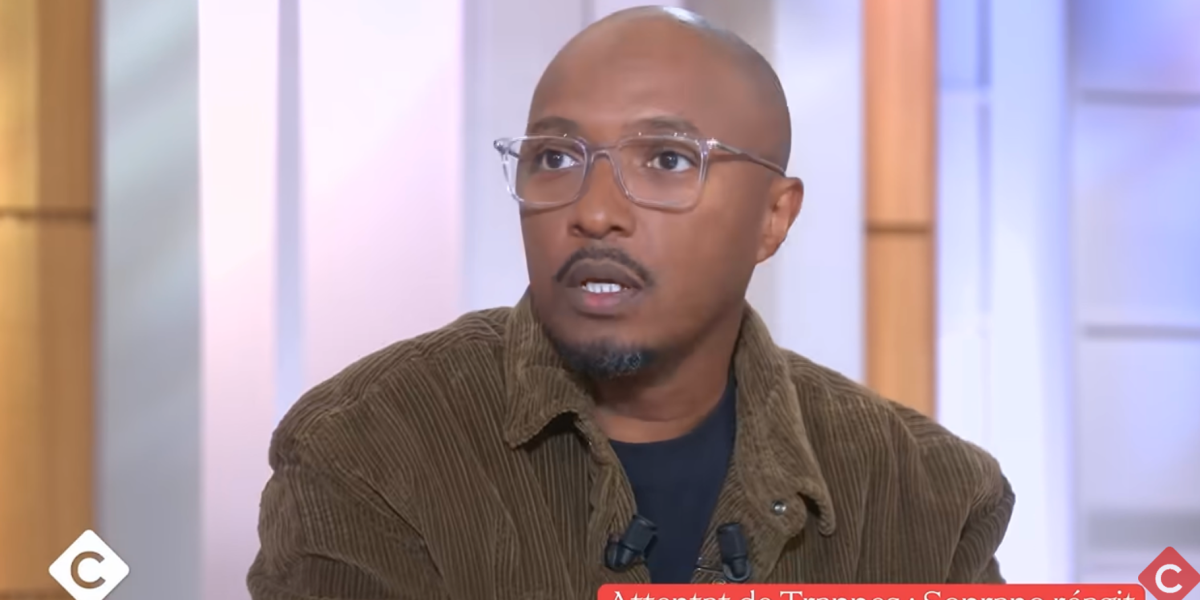
The Marseille-born rapper Soprano has pushed back against critics who argue that musicians should stay out of politics, insisting that his success and fame do not strip him of the right to speak on the future of his country.
Appearing on the France 5 talk show C à vous on Saturday, November 7, the artist addressed a familiar reproach often leveled at public figures who take political stances—particularly as the far-right National Rally (RN) gains ground ahead of France’s 2027 presidential election.
A Tradition of Social Engagement
Soprano began by recalling that artists have long engaged with social questions, citing the work of groups such as NTM and IAM, as well as singer Bernard Lavilliers, who he said sought to promote coexistence and build a more peaceful society for future generations.
He then turned to the recurring critique: “Artists, why do they speak?” he said, paraphrasing the question he often hears. “People often say: ‘Yeah, they have money, they don’t even live in the country anymore.'”
Using himself as an example, Soprano noted that he lives in Marseille and pays nearly 70 percent in taxes. “I’m not complaining about it,” he said. “I’m not complaining because I know it’s for the community, it’s to move things forward.”
‘It’s Normal to Be Revolted’
For Soprano, neither his success nor his fame diminishes his right to react to political developments. On the contrary, he argued that he has every reason to feel invested in the future of the country where he lives and raises his children.
“When I turn on the TV and see that someone is accused of taking money, and convicted twice, and I’m told he could be president, it’s normal that I—someone who works, who lives in Marseille, who lives with my family and friends—it’s normal that I’m revolted,” he said, in an apparent reference to the legal troubles surrounding National Rally figure Marine Le Pen.
Concern for Younger Generations
The rapper’s indignation is accompanied by broader anxiety about the values being passed to younger generations. He framed the defense of coexistence not merely as a political stance but as an effort to build “something more reassuring and more loving for our children.”
Soprano expressed particular concern about the normalization of hate speech. Referencing the climate that preceded the racist attack in Trappes, he stressed that such violence does not emerge from nowhere. “This isn’t something that just happened today,” he said, describing a world where “values are inverted” and “there are no nuances anymore.”
Despite his concerns, Soprano said he refuses to give in to discouragement. He intends to defend his convictions both in his music and on television.
“I continue with exemplary conduct, continuing to make songs that bring people together, to come here and have a message that unites people, not to divide them,” he said.