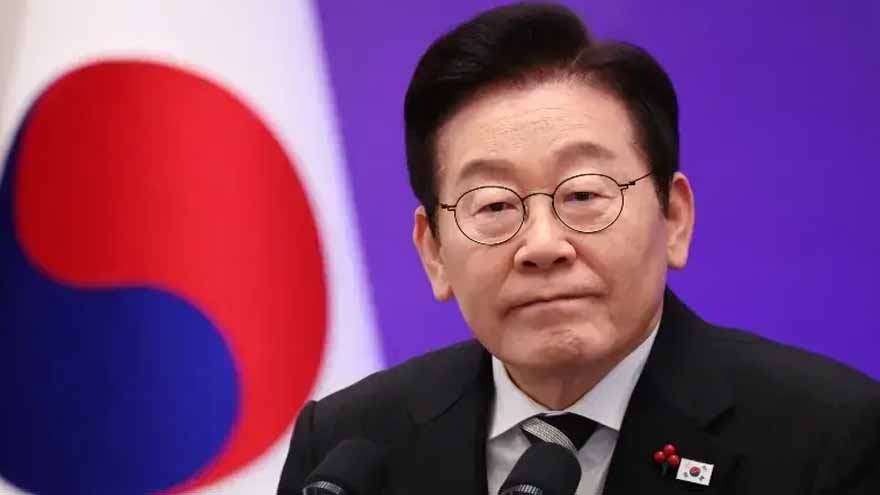
South Korean President Lee Jae Myung has called for direct negotiations with North Korea to formally end the Korean War, a conflict that has technically persisted for over seven decades. The proposal, made during a national liberation anniversary address, comes as Pyongyang deepens its military alignment with Moscow and doubles down on its nuclear ambitions.
The two Koreas have remained in a state of war since their 1950-53 conflict concluded with an armistice rather than a peace treaty. Speaking at a ceremony marking Korea’s liberation from Japanese colonial rule, Lee urged both sides to move beyond mutual threats and begin substantive discussions as the directly involved parties.
A Shift Toward Engagement
“Let us put down our intention to threaten each other and begin discussions to end the long-running war,” Lee said. He added that such talks could also open the door to “effective measures to halt the advancement of North Korea’s nuclear capabilities.”
The overture reflects a broader policy shift in Seoul. Since taking office in June last year, Lee has reversed the hardline stance of his predecessor, offering Pyongyang dialogue without preconditions. Last month, South Korea’s unification minister indicated that Seoul had moved away from prioritizing pressure on the North to dismantle its nuclear arsenal, focusing instead on curbing the expansion of its weapons programs.
Pyongyang’s Silence and Moscow’s Shadow
North Korea has yet to respond to Lee’s repeated offers. Instead, the regime has strengthened its partnership with Russia, a relationship analysts say provides Pyongyang with financial support, food, energy, and military technology in exchange for troops and munitions used in the war in Ukraine.
North Korean leader Kim Jong Un is expected to visit Russia later this year, potentially to discuss further weapons supplies. The deepening ties have raised concerns in Washington and Seoul, with US officials noting that Pyongyang’s battlefield experience in Europe could alter the threat landscape on the Korean peninsula.
Regional Tensions and Military Drills
The proposal arrives amid heightened regional friction. North Korea this week denounced upcoming annual US-South Korean military exercises, warning of stronger deterrence measures. Pyongyang has also bristled at Tokyo’s military buildup, firing two missiles in as many weeks after Japan pledged to enhance its defense capabilities.
Washington stations approximately 28,500 troops in South Korea as a deterrent against North Korean aggression. Colonel Ryan Donald, spokesman for the combined US-South Korean forces, noted this week that North Korea’s deployment to the European war had changed the threat his soldiers may face. The 11-day joint exercises are set to begin on Monday.
A Long Road to Peace
Any formal end to the Korean War would require navigating complex geopolitical terrain. North Korea has repeatedly declared itself an “irreversible” nuclear state, a position hardened after the 2019 Hanoi summit between Kim and then-US President Donald Trump collapsed over denuclearization and sanctions relief.
Lee’s proposal, while welcomed by some as a necessary step toward stability, faces significant hurdles. Pyongyang’s continued missile tests, its deepening reliance on Moscow, and the absence of a clear denuclearization framework all threaten to undermine any near-term breakthrough. Still, the call for direct talks marks a notable diplomatic effort to close one of the world’s longest-running conflicts.