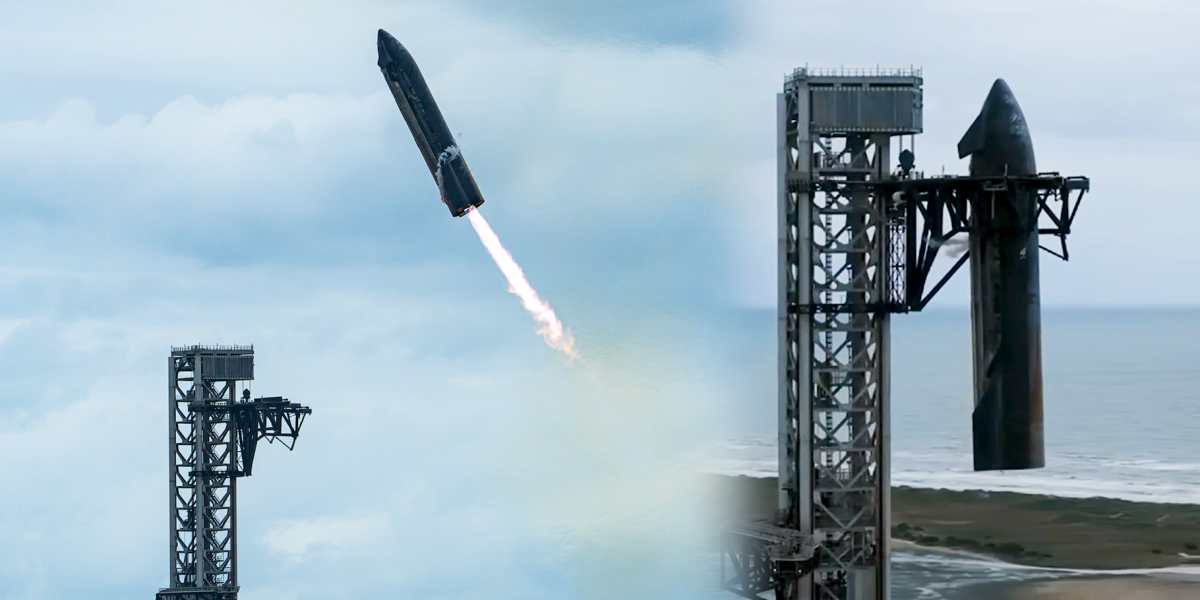
SpaceX pulled off an unprecedented feat on Saturday, November 14, successfully catching the massive upper stage of its Starship mega-rocket after more than 22 hours of flight without damaging it — a breakthrough crucial to American space ambitions.
After completing roughly 14 orbits of the Earth, the vehicle — standing more than 50 meters tall — re-entered the atmosphere at high speed and returned to the Starbase launch facility in Texas, where it had lifted off the previous day.
A Carefully Controlled Descent
Piercing through cloudy skies, the upper stage descended along a meticulously controlled trajectory and slotted between two gigantic metal arms that closed around it, as shown in footage from the event.
This spectacular maneuver was far more complicated and risky than the similar operation SpaceX has previously performed to recover the rocket’s lower stage, because the upper stage was falling from much higher and at far greater speed.
Musk Celebrates Milestone
“The big day has arrived,” Elon Musk reacted on X, thanking his teams. The world’s richest man shared videos from the tower and added that he had “hugged” the rocket stage upon its return.
The success represents a considerable advance in the development of Starship, the largest and most powerful rocket ever built, designed for missions to the Moon and Mars and to send data centers into space.
“This is an exceptional technical achievement,” said Clayton Swope, an expert at the Center for Strategic and International Studies (CSIS), speaking to AFP. It “proves that the idea of making Starship a fully reusable rocket can work,” he said.
Saturday’s success thus marks “one more step” toward returning Americans to the Moon, NASA Administrator Jared Isaacman emphasized on X, thanking the company for an “almost magical” moment.
Not a Flawless Flight
However, SpaceX did not manage during this 15th test flight to recover the rocket’s lower stage, the Super Heavy booster, as planned in a similar maneuver. Although it had done so three times in the past, the company abandoned the attempt shortly after Friday the 13th’s launch due to a technical problem. Following a detected anomaly, the vehicle diverted its own trajectory and exploded in the Gulf of Mexico, in waters bordering the space base.
While catching the upper stage constitutes “a tremendous success,” it appears that “SpaceX still has a lot of work to do to make Starship a fully reliable and reusable system,” observed Kathleen Curlee, a space analyst at Georgetown University, speaking to AFP.
The upper stage did successfully deploy 26 large Starlink satellites into orbit for the second time, but it will take “several repeated successes to prove that the system is ready to handle” commercial satellites or “sensitive missions,” she noted.
Challenges Remain
Other technical hurdles remain before Starship can be considered ready for voyages to the Moon or Mars. Among them are complex orbital fuel-refueling operations, which SpaceX has indicated it wants to begin testing soon.
- SpaceX caught the Starship upper stage for the first time after a 22-hour flight
- The Super Heavy booster was lost after an anomaly forced its self-destruction
- Starship deployed 26 Starlink satellites during the test flight
- Orbital refueling tests are the next major milestone