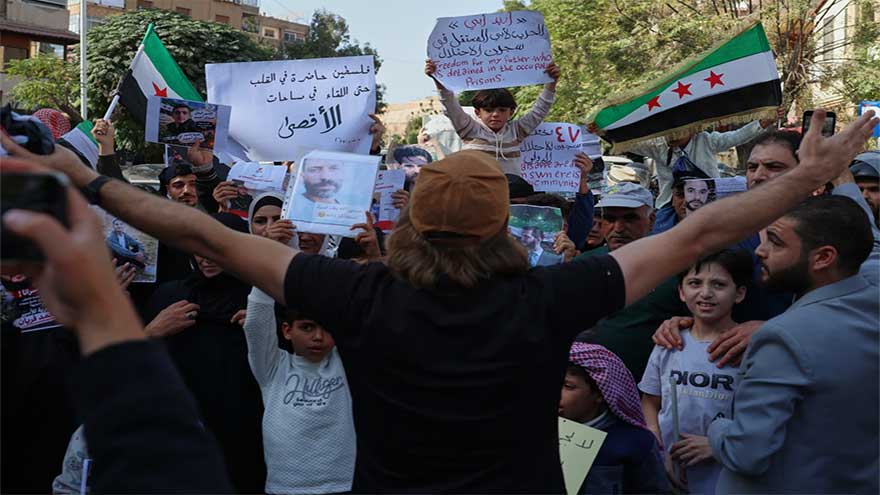
AIN THAKAR, Syria — The euphoria that swept through southern Syria after the fall of Bashar Assad has given way to fear and silence in villages near the Israeli-held buffer zone, where dozens of families say they have lost contact with relatives detained by Israeli forces and have nowhere left to turn.
Former detainees, relatives and human rights researchers describe a pattern of nighttime raids, checkpoint arrests and prolonged detention without charge — allegations the Israeli military rejects.
A Detention That Lasted Months, Without Charges
Ali al-Abdullah, 20, was taken at an Israeli checkpoint in the village of Ain Thakar in June 2025. He said soldiers asked whether he or anyone in his village was affiliated with armed Islamist groups; he told them he had no affiliation and that no such groups operated there.
He was handcuffed on the spot and spent the next five months shuttled between Israeli detention facilities. In solitary confinement at two prisons, he said, “there was no ventilation, only light,” and he was uncuffed only for a few minutes a day to eat.
“Sleeping was not allowed. You had to remain seated cross-legged the whole time and were not allowed to lie down. You would spend seven days like that,” he said.
Kinan Baker, 39, was seized in an overnight raid on his family home in August 2025. His mother, Huda Baker, said troops threatened to blow up the house unless her son surrendered within five minutes. Blindfolded and handcuffed, he was led away. The family has not heard from him since.
Wadih Baker, no relation, was stopped by an army patrol while walking in the village of Tranje in June 2025 and told he would be released in five minutes. He was held for roughly 15 months. He and al-Abdullah both said they were held at Ofer Prison near Ramallah in the occupied West Bank and later at Sde Teiman in the Negev Desert — facilities where Israeli and international rights groups have documented torture and ill-treatment of Palestinian prisoners.
Arrests Followed the Buffer Zone Seizure
Israel seized the U.N.-mandated buffer zone — a 235-square-kilometer (91-square-mile) strip established under a 1974 agreement — in December 2024, shortly after Assad’s ouster, and declared the accord void. It has since built military outposts and carried out strikes, raids and incursions in Quneitra and Daraa provinces, with activity reaching the countryside southwest of Damascus.
The Israeli military says its presence is needed to defend its northern border against Hezbollah, the Iran-backed Lebanese group that fought alongside Assad during Syria’s 13-year civil war. It said troops “question and detain individuals when there is reasonable suspicion of their involvement in terrorist activity,” rejected allegations of abuse, and declined to address specific cases because families would not provide Syrian government ID numbers.
According to Syrian government officials and U.N.-backed investigators who have accused Israel of human rights violations in Syria, 49 Syrians have been detained since December 2024, 16 of whom have been released over the past year.
The Washington-based Syria Justice and Accountability Center says former detainees and witnesses to arrests have alleged ill-treatment or torture, including being held in stress positions and threatened at gunpoint, said researcher Salma Daoudi.
Pleas That Go Unanswered
Families say appeals to the Syrian government and the United Nations for information have produced nothing.
“We can only hold on to hope in God, and pray that he reunites us with our son,” Huda Baker said.
Hassan Saad Eldin, 47, has been waiting far longer. His son Saddam was 16 in April 2024 when Israeli troops detained him while he worked in an olive grove near the village of Jabata al-Khashab — before Assad’s fall. He says he still does not know where his son is held, and that troops have blocked him from reaching his farmland.
“They bulldozed an area of 10 to 12 dunums (2.5-3 acres) of olive groves and completely demolished a full livestock stable,” he said, gesturing toward a large dirt roadblock cutting off access.
The suggestion that his village harbors armed groups baffles him. “We are civilians — farmers and agricultural workers — with no external allegiances,” he said.
He questions released detainees whenever he can, hoping for word of Saddam. One told him his son had not been harmed. But when other former prisoners describe abuses they witnessed behind bars, the reassurance fades.
Political Stalemate Deepens the Uncertainty
Israel remains wary of Syria’s new leader, Ahmad al-Sharaa, a former militant leader once linked to al-Qaida who has since rebuilt ties with Washington and Europe. Al-Sharaa has demanded an Israeli withdrawal from the buffer zone.
Mohammed Saeed, a spokesperson for Quneitra province, called Israel’s claims of militant activity there “baseless lies,” saying the civil war that toppled Assad “freed the country from occupying forces, whether they were Iranian or Hezbollah forces present in the area.”
For families in villages like Ain Thakar, the diplomatic dispute offers little comfort. With no charges, no confirmed locations and no answers, they are left to wait — and to keep pressing for news of the missing.