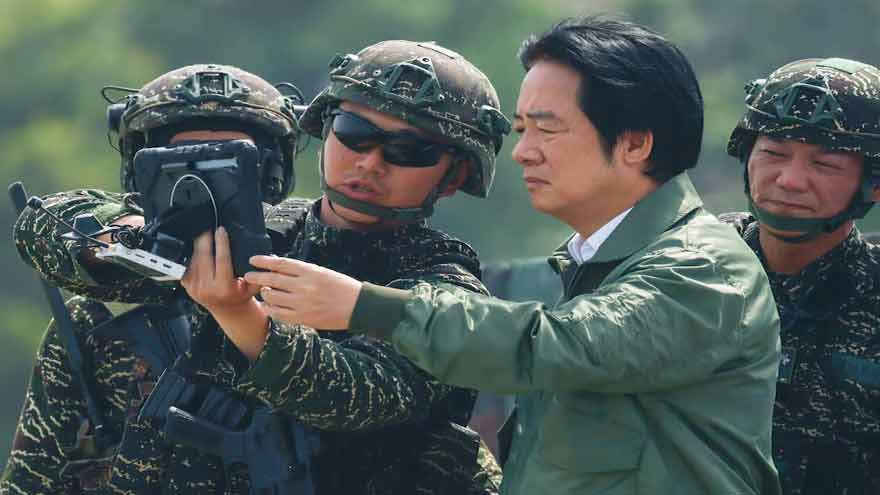
TAIPEI — Taiwan is set to allocate a record T$1.1225 trillion ($31.40 billion) to defense in 2027, a landmark figure that pushes military spending beyond 3% of the island’s gross domestic product for the first time. President Lai Ching-te announced the proposal Monday, framing the investment as a cornerstone of regional peace and a direct response to escalating Chinese military activity.
The budget blueprint, which will be formally presented by Taiwan’s cabinet on Thursday, confirms earlier media reports that overall defense expenditure would cross the trillion-dollar threshold. Lai’s announcement underscores a strategic pivot toward self-reliance, driven by both Beijing’s intensifying pressure campaign and Washington’s persistent calls for Taipei to shoulder a greater share of its own security burden.
A Deliberate Signal to Beijing and Washington
Speaking at a budget planning meeting, Lai said the 2027 allocation “demonstrates Taiwan’s determination to strengthen its self-defence capabilities.” He added that “investing in defence is investing in peace,” a message aimed at reassuring both domestic audiences and international allies that Taipei is serious about deterrence.
China, which claims Taiwan as its own territory and has never ruled out using force to achieve unification, has conducted near-daily air and naval patrols around the island. Beijing has also deployed coastguard vessels for “law enforcement” missions off Taiwan’s east coast, a tactic analysts say is designed to test Taipei’s maritime response capabilities while gathering intelligence for potential combat scenarios.
“If actual hostilities break out across the Taiwan Strait, the entire eastern maritime area of Taiwan will be Taiwan’s most critical outlet to the outside world,” said William Chung, an assistant research fellow at Taiwan’s Institute for National Defence and Security Research, during a forum in Taipei on Monday. Chung noted that China’s east coast activities serve multiple purposes: psychological pressure, combat training, and intelligence collection.
Modernization Drive Faces Domestic Headwinds
The proposed budget comes as Taiwan completes its annual Han Kuang military exercises, which simulated scenarios including breaking a Chinese maritime blockade. China’s Defense Ministry dismissed the drills as a “wasteful charade” that “stoked war panic,” a charge Taipei rejects.
Domestically, Lai faces a formidable challenge from an opposition-dominated parliament that has shown reluctance to rubber-stamp defense spending. This year’s budget was only passed late Friday after months of political wrangling, and opposition parties have signaled they will not write blank checks for the administration. The friction could complicate passage of the 2027 proposal, though Lai’s government has framed military modernization — including the development of made-in-Taiwan submarines — as a non-negotiable priority.
The defense budget’s growth trajectory mirrors broader regional trends. Japan, South Korea, and Australia have all announced significant increases in military expenditure in recent years, citing concerns over China’s rapid military buildup and increasingly assertive behavior in the Indo-Pacific. For Taiwan, the 2027 figure represents a roughly 10% increase over current levels, a pace that economists say is sustainable given the island’s robust technology-driven economy.
Strategic Implications for the Taiwan Strait
Analysts say the budget hike is unlikely to alter Beijing’s calculus in the short term, as China’s defense spending dwarfs Taiwan’s by a factor of more than ten. However, the symbolic crossing of the 3% GDP threshold — a benchmark often cited by U.S. officials — could strengthen Taipei’s case for continued American support, including arms sales and security assurances.
“This is not about matching China tank for tank or jet for jet,” said one Taipei-based defense analyst who requested anonymity to discuss sensitive policy matters. “It’s about demonstrating resolve, building asymmetric capabilities like coastal defense missiles and submarine infrastructure, and signaling to Washington that Taiwan is a reliable partner.”
Lai’s announcement also carries domestic political weight. By tying defense spending to peace, he seeks to counter opposition narratives that his administration is provoking Beijing. The framing — defense as an investment in stability rather than a provocation — is designed to appeal to a Taiwanese public that broadly supports self-defense but remains wary of conflict.
As the cabinet prepares to release the full budget breakdown on Thursday, attention will focus on how the funds are allocated across personnel, procurement, and research and development. The answer will shape not only Taiwan’s military posture but also the trajectory of cross-strait relations in an increasingly volatile geopolitical environment.