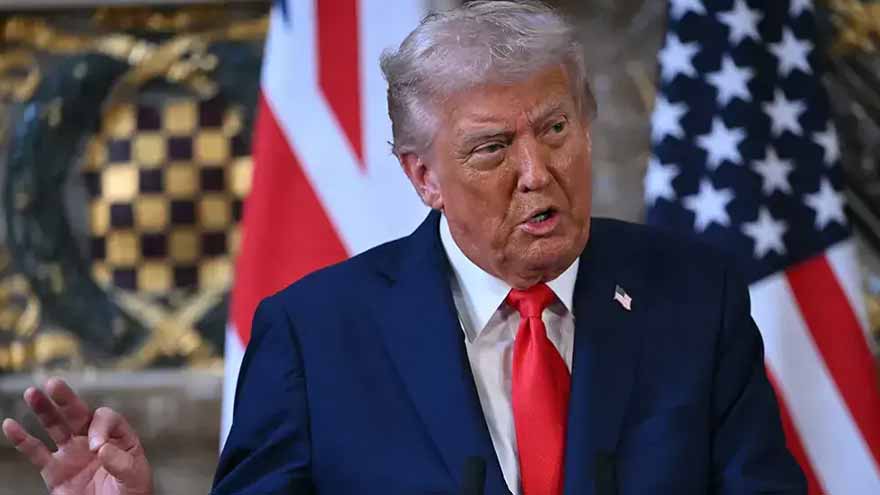
President Donald Trump arrives at this week’s ASEAN and APEC summits carrying a new and unwelcome piece of baggage: a domestic political landscape radically reshaped by a midterm election that saw Democrats seize both the House of Representatives and the Senate.
Politically hamstrung as he enters the final two-year “lame duck” stretch of his White House tenure, the 80-year-old Republican now faces a pointed challenge — demonstrating to world leaders that he remains the architect of US foreign policy, even as the balance of power in Washington shifts beneath him.
Constitutionally barred from seeking a third term in 2028, Trump may be all the more inclined to channel his energy onto the international stage, where he is unlikely to face public questioning on domestic politics.
A Familiar Playbook for Presidents Under Pressure
“After bad midterms, this is how presidents reset,” Edgard Kagan, an expert at the Center for Strategic and International Studies, told a news briefing.
Beijing has described the midterms as an “internal affair” and said it is “willing to continue working” with Washington after Republicans lost control of both chambers of Congress. But the power shift is unlikely to go unnoticed in the corridors of the summits.
“In private, many (Asian) leaders are relieved,” Joshua Kurlantzick, a Southeast Asia and South Asia expert at the Council on Foreign Relations, wrote in an article this month.
He noted that the Iran war has been particularly challenging for US partners and allies in Asia, who “hope that after the midterm results US President Donald Trump’s decision-making on the issue will become more predictable.” Trump has said repeatedly since the midterms that renewed fighting between Washington and Tehran is unlikely.
Trade and China on Leaders’ Minds
A Democratic-controlled Congress could also take a tougher stance toward China, Kurlantzick added, potentially reversing the administration’s “soft approach” to Beijing that has stirred unease among US allies in Asia.
Asian leaders are likewise hoping Democrats will push back on Trump’s barrage of tariffs on trading partners — measures that have stung export-reliant economies across the continent. Democratic House leader Hakeem Jeffries has urged Congress to reassert its authority over US trade policy.
Undoing Trump’s agenda will not be easy, however. The president retains broad authority over trade and holds veto power over congressional legislation — a power he has vowed to use.
The Meeting as the Message
Trump has long relished dramatic gestures, and foreign policy offers an ideal stage for high-profile encounters — particularly with Chinese President Xi Jinping and Russian President Vladimir Putin. Trump told reporters this week he expects to meet both leaders at the APEC summit in Shenzhen, China, scheduled for November 18-19, with “denuclearisation” and ending the war in Iran on the agenda.
But the bigger goal may simply be a single photograph of Trump standing alongside the two leaders he views as his great-power equals, according to Kurt Campbell, chair of The Asia Group and a senior diplomat during the Biden administration.
“I think in many respects this could be ‘the meeting is the message,'” Campbell said.
Ukrainian President Volodymyr Zelensky, who watched with alarm as the White House appeared to pivot toward Moscow this year, has warned against a “Yalta 2.0” — a reference to the 1945 conference at which Western leaders divided Europe with the Soviet Union.
Victor Cha, president of geopolitics and foreign policy and Korea chair at CSIS, said the Republican defeat made a high-profile meeting all the more likely — and pointed to North Korea as a legacy issue Trump has personally invested in across two terms.
“There’s nobody else in the US government that makes policy on North Korea except the president, so I think that he’ll be focused on that sort of legacy issue,” Cha said.