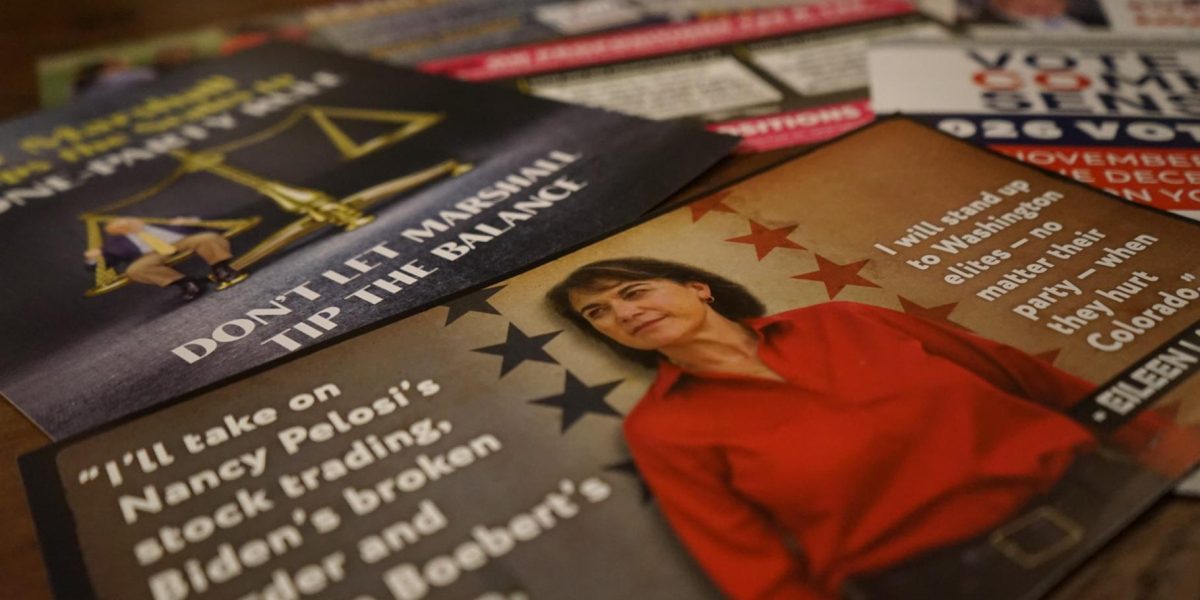
In the United States, sometimes all it takes to know an election is near is a glance inside your mailbox. For weeks, mine in Colorado has been filling up with political mailers: oversized postcards, flyers in garish colors, slogans printed in capital letters and photos of candidates smiling to varying degrees. With the midterms just days away, it is hard to escape the campaign.
Some mailers promise to defend public schools, others to cut taxes or protect families. One bright yellow flyer backs a local proposal on school funding; its Democratic sponsors promise better teacher pay, smaller classes and more transparency on spending. Other documents address health care, public safety, purchasing power and taxation.
And then there are those that prefer to attack their opponents directly. One Democratic flyer is devoted entirely to Lauren Boebert, the Republican congresswoman. A staunch Donald Trump supporter known for her deeply conservative positions and absolute defense of gun rights, she is not spared.
A Glossy Attack Ad, Signed with a Wink
On the glossy paper, Boebert appears all smiles, surrounded by $100 bills, first-class plane tickets and a high-end fountain pen. “Lauren Boebert thanks you for funding her luxurious life in Washington.” The document targets her policies but also her spending. “Thanks for the cash. Love you,” adds a fake handwritten signature, as if the congresswoman were addressing voters herself—a hardly subtle way of accusing her of living large at taxpayers’ expense.
In short, my mailbox looks like a snapshot of Americans’ concerns. But leafing through this haul, one detail struck me: Donald Trump does not occupy the central place I had expected. Yet it is hard to find a figure more omnipresent in American political life.
The Stickers That Tell Another Story
Pondering this, I remembered another very American little object that proliferates at the gas stations around me: stickers. They show Donald Trump pointing at the price displayed on the pump, accompanied by three words—”I did that.”
Does that ring a bell? It should. During Joe Biden’s term, nearly identical stickers—except bearing the Democrat’s face—also flourished on gas pumps. The idea was to pin the blame for rising fuel prices on him, and to say so loudly. Today the roles are reversed: Trump is in the White House, and it is his face that appears next to the posted prices.
Here, the car is king. In my corner of Colorado, it is hard to do much without getting behind the wheel—work, groceries, school. Distances are long and public transit is very limited. As a result, Americans spend a lot of time on the road, and therefore at the pump, where posted prices are watched closely. Since the start of the war in Iran, they too have reached record highs. For perspective: when I bought my car three years ago, a full tank cost me $40. Today, filling up costs me more than $80. That is bad news for drivers—and for Trump, who promised to bring prices down and restore Americans’ purchasing power.
Of course, a sticker does not make an electoral trend, any more than a handful of flyers can measure the state of American public opinion. But these small everyday signs make you want to look at the campaign more closely.
A President Unusually Absent from the Trail
All the more so because other observers have also noted a certain discretion, unusual for the president, on the campaign trail. Philippe Corbé, a French journalist who has long crisscrossed the country’s roads, recently expressed his astonishment after a trip to Pennsylvania. “What struck me yesterday is that I hardly saw any Trump signs,” he wrote. In those rural and industrial regions, where Trump built part of his electoral success, signs bearing his name had become a familiar part of the campaign landscape. “This time, I counted them on one hand,” he added in his newsletter Zeitgeist.
An investigation published by The New York Times on October 19 shows just how discreet Trump has become in his own camp’s advertising. Between September 9 and October 17, 2026, less than 1% of Republican advertising spending for these elections went to spots that explicitly mention his name. Among their Democratic opponents, that proportion climbs to 20%.
What stands out to me is the shift in strategy. During the Republican primaries, according to the same newspaper, nearly 55% of advertising spending went to spots mentioning Trump. Candidates were mainly trying to win over the party base, for whom the president’s support remains an asset. But for the November general election, they must also convince independent and undecided voters—a task for which Trump’s sagging popularity can be a poisoned chalice.
On the Democratic side, the bet is once again the opposite. Voters are reminded that Republicans—whoever they are—back a president and a movement (MAGA) with which they profoundly disagree: the war in Iran, gas prices, tariffs. The subjects are plentiful.
Meanwhile, Trump is asking his supporters to vote “as if his name were on the ballot.” The stakes are high: if Democrats take control of all or part of Congress, it will become far more complicated for the president to implement his agenda—and his legal troubles could return as well.
In the end, perhaps that is the great paradox of these midterms: Trump wants Americans to vote with him in mind, and so do the Democrats. But much of the president’s own camp seems to be hoping for exactly the opposite.