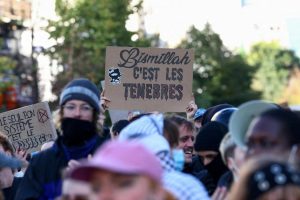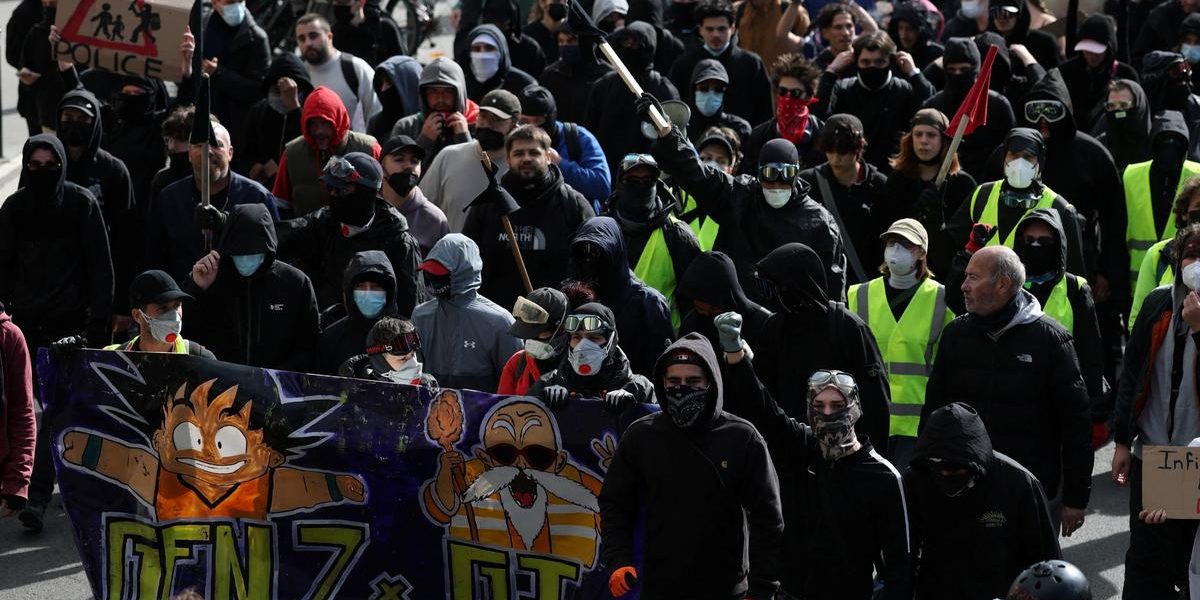
The coordination of the gilets jaunes movement said Wednesday it had formally filed a declaration with the prefecture to demonstrate in Paris on Saturday, setting the stage for a second weekend of protests a week after a rally against the high cost of living descended into chaos in the capital and several other cities.
A representative of the October 17 coordination told France 2 that the paperwork had been submitted for a route running from Place de la Bastille to Opéra. “I have just sent, with a few colleagues, a declaration to the prefecture for a route that starts at Bastille and goes to Opéra,” said Benjamin Ball, who publishes a site mapping all the actions planned for Saturday’s “Act II” of the movement. He added that the CGT union’s Paris branch and the student union have also announced they will gather at Bastille.
Government Promises ‘Massive’ Police Deployment
After last Saturday’s riots and looting in several cities, Prime Minister Sébastien Lecornu has promised that the police deployment for the new October 24 demonstrations will be “massive.” The announcement came as localized curfews were imposed for another night in parts of the country.
Lecornu was due on Wednesday to receive trade union organizations to discuss securing protest processions and the government’s response to high-school students, although student representatives were not invited to the meeting.
Unions Turn Up the Heat on the Prime Minister
Sophie Binet, general secretary of the CGT, said she had not seen Lecornu “for thirteen months” and urged him to “come out of his bunker” and heed what she called an enormous social mobilization. She called on the government to treat young people and workers as well as it treats employers, saying “we have been humiliated for ten years.”
Binet also rejected suggestions that La France Insoumise bears responsibility for the unrest, describing the party as “a party like any other” and accusing the prime minister of suffering from “acute Mélenchonitis.” She said France had become “the laughing stock of the world because the prime minister is stubborn and refuses to respond to demands.”
Opposition Rounds on the Executive
Former president François Hollande, now a deputy, told France Inter that there had been “very serious failures” in maintaining public order and “a lack of experience,” arguing that the government had underestimated the anger building over several weeks and deployed insufficient police numbers. “We are dealing with a weak government, an absent president of the Republic and ministers who do not necessarily have experience,” he said.
Édouard Philippe, the Horizons presidential candidate and former prime minister, renewed his criticism of Emmanuel Macron, saying on France 2 that while he welcomed measures to restore order, “it is time.” He deplored that the president had “announced finally not much at all” and questioned the timing of Macron’s trip to the Gulf, calling it “not the most opportune” decision. Philippe said he wanted to give more powers to municipal police, insisting “it is not about turning them into riot police,” and backed a “absolute firmness” in the penal response to vandals.
Éric Ciotti, leader of the UDR and mayor of Nice, accused the government of an “completely incoherent” management of public order, claiming that “less than half of the possible police staffing was mobilized.” He described the attack on Limoges town hall as “an act of terrorism” and pointed to what he called the responsibility of the ultra-left in relaying calls to violence. Ciotti also claimed that “a third of the vandals on October 17 were foreigners” and called for their immediate expulsion.
Ministers Seek to Reassure Business Owners
Economy Minister Roland Lescure said the weekend’s events were “extremely serious” and that “France was attacked from within by anarchists and thugs,” urging calm and responsibility so that “it does not happen again.” Responding to warnings from the head of insurer Axa that repeated unrest would make it harder to compensate victims, Lescure said the state would put in place a “extremely firm” mechanism while insisting that “the role of an insurer is to honor its contracts.”
Serge Papin, the minister for small businesses, commerce, crafts, tourism and purchasing power, confirmed on BFM Business the creation of a support fund for traders worth “several million euros,” reserved for companies with fewer than 50 employees. He said the aid would be available immediately rather than waiting for the 2027 budget, and that shopkeepers “can have confidence” in a secure environment on October 24.
Alexandre Bompard, chief executive of Carrefour, told France Inter he had seen “entrepreneurs with fear in their eyes” after looting at some of its franchised stores, and rejected any link to purchasing power. “What was stolen in our stores this weekend was not food, it was strong alcohol, for trafficking,” he said, warning that “self-defense reflexes” were emerging among shopkeepers when “the law and the Republic must always prevail.”
Welfare Cuts for Rioters Under Scrutiny
Vincent Jeanbrun, the minister for cities, defended on TF1 a government circular aimed at stripping convicted rioters of welfare benefits, arguing that “the law allows it as long as all the organizations talk to each other.” Under the plan, money improperly earned by a convicted vandal or looter would be counted as income, meaning social minima would no longer be paid and overpayments would have to be reimbursed. Asked whether the measure was fair when it could penalize an entire family for one child’s actions, Jeanbrun said “the family is a recognized entity in France, there is a solidarity.”
Renaud Muselier, the newly elected senator for Bouches-du-Rhône, claimed that between “15,000 and 30,000 looters” had descended on Marseille on Saturday, describing the scenes as “the convergence of brutes” rather than “the convergence of struggles.” His figures were contested by the city’s Socialist mayor, Benoît Payan.