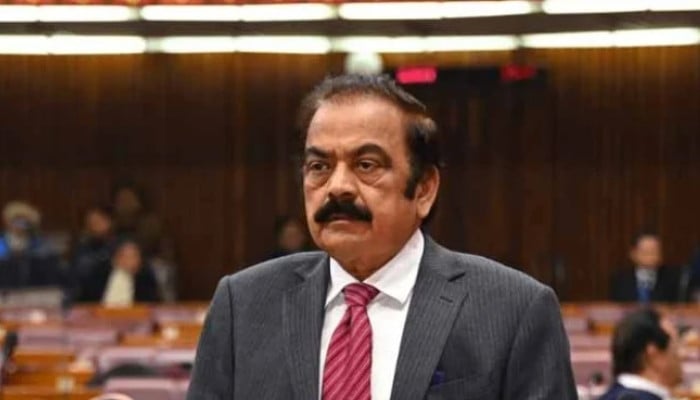
A senior adviser to Pakistan’s Prime Minister has leveled serious allegations that foreign entities, including members of the diaspora in the United Kingdom, are financially backing a recently proscribed organization in Azad Jammu and Kashmir (AJK). Rana Sanaullah, Adviser on Political Affairs, stated that the Jammu Kashmir Joint Awami Action Committee (JAAC) rejected multiple government proposals designed to peacefully resolve escalating political tensions.
Rejected Offers and New Demands
Speaking during a televised interview, Sanaullah detailed the government’s attempts to de-escalate the situation before the group was officially banned under the Anti-Terrorism Act on June 5. The ban was imposed just days before JAAC planned a major protest seeking the abolition of 12 seats in the AJK Assembly reserved for refugees from Indian Illegally Occupied Jammu and Kashmir (IIOJK).
Sanaullah claimed the group introduced a novel demand during recent negotiations. “They made the demand in October 2025 along with other 38 demands,” he said, noting that JAAC also sought the removal of a fundamental declaration from election candidacy papers—the clause stating that Kashmir would accede to Pakistan after independence.
To avert the planned June 9 protest, the federal government offered a range of conciliatory options. According to Sanaullah, these included holding a referendum on the refugee seat issue, convening an all-parties conference, or referring the matter directly to the AJK Assembly for a legislative decision. However, he asserted that the proscribed outfit rejected all options, insisting on confrontation.
‘External Hand’ and Refugee Representation
Defending the integrity of the refugee seats, Sanaullah dismissed allegations that they are used for electoral rigging. He argued that the seats are constitutionally reserved for those who migrated from IIOJK, questioning the logic of removing their representation.
“If you take out the refugees from the Jammu Valley, what becomes of your movement for IIOJK’s freedom?” he asked. While reiterating the public’s right to peaceful assembly, the adviser issued a stark warning that no group has the right to take up arms or forcibly occupy cities like Islamabad or Muzaffarabad.
Echoing the gravity of the crisis, AJK Prime Minister Faisal Mumtaz Rathore admitted that the situation in the region is dire. “I will certainly not say that the situation in Azad Kashmir is good,” Rathore stated in a separate interview, describing the unrest as a significant test for the state.
Rathore lamented the human cost of the protests, emphasizing that lives lost could not be disregarded. He also pushed back against criticism directed at his administration, revealing that JAAC had specifically demanded to negotiate only with the federal government, seeking to exclude the AJ government from the reconciliation process entirely. The premier maintained that his government had fulfilled all commitments made during previous understandings with the group.