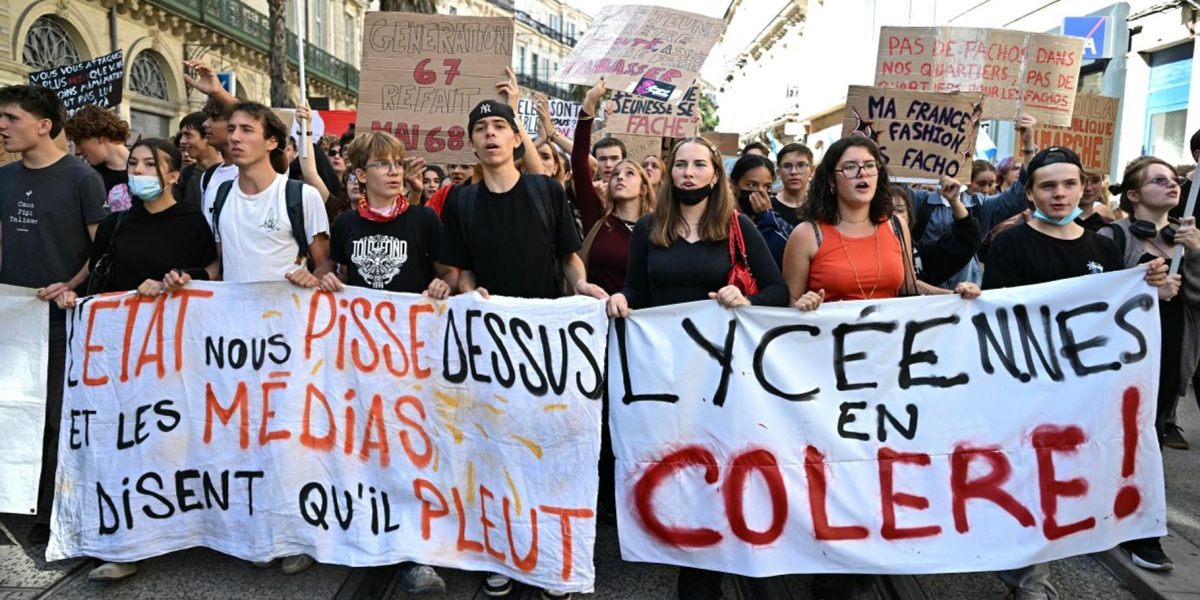
Blockades at secondary schools across France continued on Thursday, October 8, as student mobilizations entered a new phase, testing the government’s preferred approach of dialogue and consultation against a backdrop of concrete, unmet demands.
Government Bets on Dialogue as Blockades Continue
Education Minister Édouard Geffray has remained steadfast in his commitment to consultation. “I profoundly believe that when you have a constructive discussion, where you give lycéens the floor, you are able to bring answers,” he said Thursday morning following an exchange with students in Reims.
That same philosophy underpinned the launch of a government “consultation platform,” which reportedly gathered 30,000 contributions within 24 hours, according to Prime Minister Sébastien Lecornu on October 7. A “period of internal democracy” was also proposed for the end of the week in schools. A further meeting between student representatives and the education and higher education ministers was scheduled for Thursday afternoon.
Yet the emphasis on dialogue has failed to satisfy students, who are pressing concrete demands regarding school infrastructure, the organization of their working time, teacher shortages, and the Parcoursup university admissions system. A June 2025 Cevipof survey confirmed growing public interest in participatory democracy, but its track record in practice has proven discouraging.
A Mixed Record for Participatory Democracy Under Macron
Giving voice to discontent was, in part, what allowed Emmanuel Macron to defuse the first major crisis of his presidency. When the Yellow Vest movement erupted in December 2018, the “great national debate” and the “cahiers de doléances” made available to citizens helped calm social anger. More than 450,000 pages were filled. Yet few elected officials have claimed inspiration from them, despite researchers’ and local representatives’ years-long complaints about the absence of follow-up.
The president subsequently established the Citizens’ Convention on Climate, which in June 2020 produced nearly as many proposals as its 150 randomly selected participants. The resulting Climate and Resilience bill, however, left convention members bitter, as they judged their recommendations insufficiently incorporated.
In late 2022, Macron launched a citizens’ convention on end-of-life issues. Participants ultimately favored legislation permitting assisted suicide. After numerous obstacles, the text was finally voted and promulgated in August 2026.
Some initiatives produced concrete change; others carried little weight in political decisions. The most damaging precedent for the government amid the current lycée mobilization is the Citizens’ Convention on Children’s Time, organized throughout 2025.
The Children’s Time Convention: A Warning Ignored
That consultation aimed specifically to “ensure that the organization of our students’ days is more favorable to their development and learning, and that a balance is found to facilitate family life,” according to the president himself. The report, delivered in November 2025, recommended pushing the start of middle and high school classes to 9 a.m., a minimum 1.5-hour lunch break, a five-day school week with lighter daily schedules, and a 20-to-30-year infrastructure plan. It resulted in no political commitment.
According to participants, a meeting took place earlier this year with the education minister, who deferred all debate on school rhythms to the 2027 presidential election. A late-September meeting at the Culture Ministry produced no follow-up.
“What was an alarm bell a year ago is today expressed directly by a segment of the youth population — so let us listen to them,” the Citizens’ Convention association appealed on Instagram. “It is a great pity that we were not heard; it could have shown these young people that they were being listened to,” said Marie-Josée Balducchi, a Cese member representing the National Union of Family Associations and part of the convention’s governance committee.
Time and Money in Short Supply
Listening to lycéens’ demands is precisely the instruction Macron has given his government. But going further on issues like school infrastructure and school time — which require deep reforms — takes time and money, both of which are in critically short supply for the executive as the presidential term draws to a close.
On Wednesday evening, Lecornu committed to “translating” lycéen contributions into the 2027 budget bill. On Thursday, Geffray promised an “emergency plan” within “a few hours or a few days” regarding the non-replacement of absent teachers.
At Saint-Exupéry high school in Créteil — the first to mobilize in mid-September — classes resumed Monday, October 5. The result stemmed from dialogue between students, teachers, and the regional education authority, but above all from concrete actions taken afterward, including several immediate recruitments.