What began as a grassroots movement by French high school students demanding better educational resources has spiraled into a nationwide wave of protests marked by violent clashes, vandalism, and hundreds of arrests. The unrest, now in its fourth day of major mobilization, has drawn condemnation from international organizations and prompted emergency responses from the French government.
Violence Erupts at Bastille Demonstration
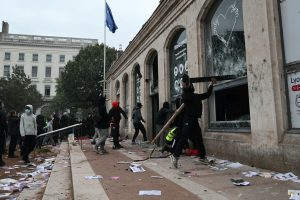
In Paris, tensions boiled over Thursday afternoon as tens of thousands gathered at the Place de la Bastille. According to the Paris police prefecture, projectiles including paving stones and fireworks were launched at security forces positioned along Rue de la Bastille around 4:20 p.m. Approximately thirty minutes later, a group of roughly twenty masked individuals threw street furniture at police, who responded with water cannons and tear gas.
Videos circulating on social media showed groups of young people hurling various objects and tree branches at officers, who retaliated with tear gas grenades. Due to the escalating incidents and the massive crowd density, authorities coordinated with organizers to redirect the procession toward Place de la Nation via multiple routes.
Earlier in the afternoon, dozens of students had climbed the July Column at Bastille, reportedly calling for a “storming of the Bastille” in a symbolic reference to the French Revolution.
School Vandalized Near Bordeaux
A high school in Lormont, a suburb of Bordeaux, was partially ransacked Thursday morning by masked youths who stole approximately ten computers and set fire to a stockpile of paper, causing damage estimated in the hundreds of thousands of euros. Principal Thierry Malewicz told reporters that the burned paper alone was valued between 100,000 and 200,000 euros, while the stolen computers cost roughly 3,000 euros each.
Following what the principal described as a “very successful” general assembly, masked individuals breached the multi-purpose school, vandalizing classrooms, smashing windows, and destroying computer equipment. The Bordeaux public prosecutor was scheduled to visit the site to assess the “serious damages.”
Unicef Calls for De-escalation
The United Nations Children’s Fund issued a statement Wednesday calling for “de-escalation of violence” and “protection of minors” amid the ongoing high school movement. The French branch of Unicef emphasized that “adolescents have the right to be heard, to participate in decisions affecting them, and to demonstrate peacefully.”
“Protesting freely and safely is a fundamental right for children and adolescents,” the agency stated, noting that this right is enshrined in the International Convention on the Rights of the Child. Unicef urged law enforcement operations to “fully” consider the age of participants, “not treat the crowd as a homogeneous group, and distinguish between those committing violence and those protesting peacefully.”
Several minors have been seriously injured since the movement began as a result of police interventions. The General Inspectorate of the National Police has been assigned eighteen investigations.
Students Face Legal Consequences
Three teenagers aged 14 and 16 were presented before a children’s judge in Orléans on charges of publicly glorifying terrorism after being filmed on October 1 singing rap lyrics praising terrorism in front of their school, François Villon High School in Beaugency. The prosecutor requested judicial supervision with a ban on using Snapchat and TikTok for the two 16-year-olds, and a provisional educational measure with an assembly ban for the 14-year-old.
Incidents Spread Across France
In Rennes, a demonstration ended in violence as masked individuals stole chairs from cafes and shattered a bank window. Police made two arrests near Charles-de-Gaulle esplanade and deployed tear gas. A video showing a police officer violently restraining and striking a minor against a wall prompted the local prosecutor to open an investigation.
In the Morbihan region of Brittany, school principals reportedly faced “physical intimidation” and were “violently confronted by protest participants.” Authorities also denounced vandalism, including the destruction of the entrance gate at Dupuy-de-Lôme High School. The regional prefect called on all participants to show “calm, responsibility, and civic sense.”
In the Lyon area, approximately 3,500 people marched from Bron, dispersing peacefully according to police figures.
Private Schools Join Movement
For the first time since the movement began, students at elite private schools in Paris’s affluent neighborhoods blocked their institutions Thursday, expressing solidarity with public school students whom they described as less privileged. Students blocked entrances at the Catholic Institute of Paris, Notre-Dame-de-Sion, Sainte-Geneviève, and the prestigious École Alsacienne. At Assas University, traditionally a right-wing student stronghold, hundreds organized a blockade for the first time.
Government Responds
Education Minister Édouard Geffray announced he would present an “emergency plan” addressing the non-replacement of absent teachers within “hours or days.” Speaking in Reims after meeting students at Raymond Kopa Vocational High School, he said he would explain government actions on teacher replacements to student organizations later in the day.
The minister was scheduled to announce “first concrete measures” for high school students during TF1’s 8 p.m. news broadcast Thursday, according to the Prime Minister’s office.
During his visit to Reims, students described deteriorating conditions, including buildings with “only one working toilet and no toilet paper” and teachers absent for entire school years without replacement. Several students also shared difficulties finding internships crucial to their vocational training.
Growing Mobilization
Ryad Rani, president of the High School Union, claimed “2,000 high schools are shut down” Thursday, a figure significantly higher than the Education Ministry’s count of 157 closed institutions by midday. Rani stated the “mobilization will continue,” criticizing Prime Minister Lecornu for offering no concrete responses to student demands.
Student and professional unions have called for another day of mobilization and strikes on October 13. “As long as we don’t have 10 billion on the table, we will continue to mobilize,” said Sabrine Kharbach, spokesperson for the Student Union.
Among their demands, students are calling for 250,000 additional university places and the elimination of the Parcoursup selection platform. Higher Education Minister Philippe Baptiste dismissed the latter demand as “immense demagoguery.”
In a prerecorded address Wednesday evening, the Prime Minister stated that “no one can be indifferent to the anxieties” of high school students and that law enforcement “does not have instructions” to confront them.
Journalist Injured
Valentin Levetti, a video journalist with the Stup. média collective, filed a complaint Thursday for aggravated voluntary violence after being struck head-on by a plainclothes police officer on an unmarked motorcycle Friday while filming a demonstration outside Clemenceau High School in Montpellier. The journalist, who was wearing a “press” vest and holding a camera, suffered a hematoma, abrasions, and injuries consistent with a mild right knee sprain.
The Hérault prefecture banned all processions in central Montpellier, citing “high risk of public order disturbances.”