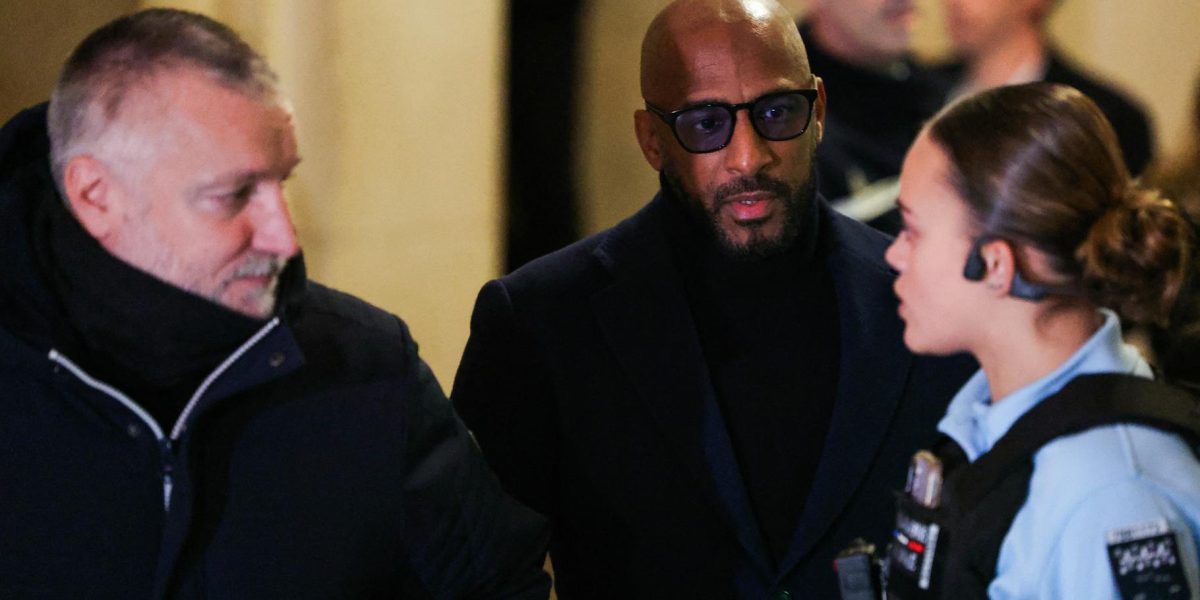
Rapper Stomy Bugsy struggled to hold back tears as he took the witness stand at the Paris criminal court on Thursday, November 12, testifying at the trial of three police officers accused of beating his friend Michel Zecler in November 2020.
“Of all the people I know, Michel is the one who deserved this the least,” the artist said, according to journalists covering the proceedings. He had to pause several times to compose himself while describing how the assault profoundly changed the music producer.
‘I Could Have Died Under Their Blows’
“I’m not as calm and polite as he is. I don’t have his build. If I had been in his place, the blows he took, I couldn’t have taken them. I could have died under the blows of these three police officers,” Stomy Bugsy declared, according to Mediapart journalist David Perrotin, who was present in the courtroom.
Since that night, the rapper says he no longer fully recognizes his friend, once cheerful, funny, and always ready to launch new projects. After organizing the “Golden Age of French Rap” tour featuring artists from the 1990s, Zecler had planned to repeat the experience with rappers from subsequent decades. But those projects never materialized.
“It all fell through,” Stomy Bugsy lamented. “Michel had so many dreams, so many projects.” Nowadays, he added, “when you talk about work with Michel… if 20 minutes pass without him mentioning this assault, it’s a miracle.”
“I want to find the Michel of before. He still has that humanity in him, but there’s always a sadness in him, a light that has gone out,” he confided, according to franceinfo journalist Violaine Jaussent.
Fred Musa Pays Tribute to a ‘Quiet Strength’
Fred Musa, the longtime host of Planète Rap on Skyrock, shares that sentiment. He also worked with Zecler and remembers his energy. The radio host described a particularly diplomatic man, capable of defusing conflicts without ever losing his temper—a personality he struggles to recognize today.
“Sometimes I want to tell him ‘get out of this case, move on,’ but I haven’t lived through what he has,” Musa acknowledged before the court.
He paid tribute to that “quiet strength,” broken by a “deluge of violence.” He said he hopes the trial will allow his friend “to breathe and move on, to want things again,” because “something has truly gone out in him since that November evening in 2020.”
‘Everything Changed’
Anne-Valérie Atlan, Zecler’s business partner, also described a man whose life was upended. Together they had founded a recording studio—”their dream”—in Paris’s 17th arrondissement. But her testimony revealed a tragic irony: the day before the assault, they had just produced a music video inspired by Mathieu Kassovitz’s film “La Haine,” imagining a different ending from the movie’s final confrontation. Instead of the film’s showdown, they chose to have the police officer lower his weapon, displaying a pacifist message: “Love is stronger than hate.”
“And the next day, Michel is savagely beaten by these police officers,” her associate continued, recalling that Zecler had specifically wanted to help ease tensions between young people and police.
Since then, their business activity has collapsed. The studio was gradually abandoned, partly because of the lingering smell of tear gas used by police. “It was extremely unpleasant—after a few seconds, your eyes stung,” she recounted.
Atlan explained that Zecler was unable to work for the two years following the assault and still suffers significant daily difficulties. “Even today, he has many absences, he can’t keep an appointment, he falls asleep after a few minutes. It’s becoming extremely difficult to hide his difficulties.”
“He was someone soothing. It’s not that he isn’t anymore, but he obsessively replays this assault. Everything changed—he’s no longer the same person,” she summarized. On the civil parties’ bench, her former associate was visibly moved, wiping his eyes.
‘Barely Recognizable’
The day’s proceedings also allowed those who were inside the studio at the time of the events to testify. Gilles L., then 19 years old, described how an evening spent listening to music had turned when he heard unusual noises near the entrance. “We tried to open… We started pushing and heard Michel’s screams—screams of pain, calls for help, and especially very distinct blows,” he testified.
Managing to partially open the studio door, Gilles L. discovered Zecler with a bloodied face, surrounded by police officers. Along with other young people present, he tried to help before eventually taking refuge in the basement, frightened by a noise he took for a gunshot. Mohamed A., also present, claimed to have heard racist insults uttered by the officers, which they deny.
The aggravating circumstance of racism, which was set aside when the three officers were committed for trial, could be reexamined at the time of the verdict on November 20.