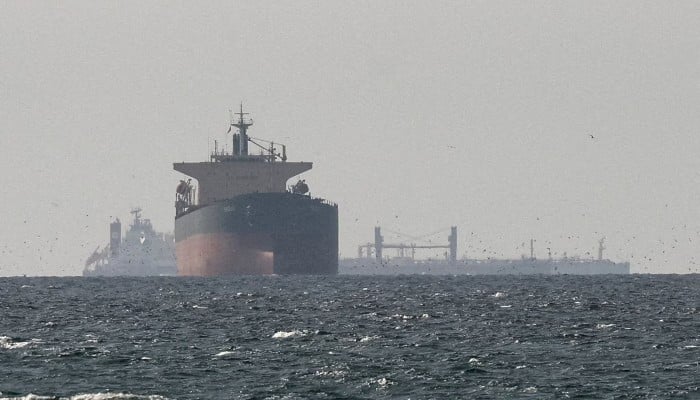
SINGAPORE — Global oil markets suffered a dramatic sell-off on Monday, sending crude prices to their lowest levels since March, after the United States and Iran reached an initial agreement to end hostilities and reopen the Strait of Hormuz, a critical artery for global energy supplies.
Brent crude futures tumbled $3.58, or 4.10%, to $83.75 a barrel, while US West Texas Intermediate (WTI) crude fell $4.01, or 4.72%, to $80.87. The sharp declines extended a more than 3% rout from Friday, as traders aggressively unwound the geopolitical risk premium that had been baked into prices for months.
A Breakthrough Deal in Switzerland
The breakthrough was confirmed by multiple parties. Prime Minister Shehbaz Sharif, whose nation served as a mediator, announced that the US and Iran will sign a memorandum of understanding in Switzerland on Friday. US President Donald Trump stated on Sunday that the Strait of Hormuz would be reopened “toll free” and that a naval blockade of Iranian ports would be lifted.
Iran’s semi-official Mehr news agency reported that the draft deal mandates the strait’s reopening within 30 days under Iranian arrangements. A more comprehensive agreement is expected to be negotiated during a 60-day ceasefire period, according to Iran’s deputy foreign minister, Kazem Gharibabadi.
“The geopolitical risk premium that had been built into crude is now being unwound quite aggressively as traders price in the prospect of restored oil flows,” said Tim Waterer, chief market analyst at KCM Trade.
Easing a Global Supply Chokehold
The Strait of Hormuz, a narrow chokepoint through which one-fifth of the world’s oil and liquefied natural gas supplies transit, had been effectively closed for more than three months due to the conflict. The blockade erased millions of barrels of supply from global markets, driving up energy costs and fueling inflation fears worldwide.
Market analysts are now closely monitoring how quickly Middle Eastern producers can restore production and export capacity following wartime damage, and whether shipping companies will swiftly return to the region.
Vivek Dhar, a commodities strategist at Commonwealth Bank of Australia, noted in a client report that oil flows through the strait only need to reach 60-70% of pre-war levels to push markets back into oversupply territory. “While these uncertainties suggest upside risks to our forecast for Brent oil futures to reach $80/bbl by the end of the year, it’s worth noting that a partial restoration of flows could rapidly rebalance the market,” Dhar wrote.
Sanctions Relief and Nuclear Talks on the Horizon
The E4 nations—comprising the UK, France, Germany, and Italy—signaled on Sunday they are prepared to lift sanctions on Iran in response to concrete steps on its nuclear program, adding further downward pressure on oil prices by suggesting a broader normalization of economic relations with Tehran.
However, some analysts urged caution against expecting a continuous freefall in prices. Tony Sycamore, market analyst at IG, pointed to the uncertainty surrounding the next 60 days of negotiations, particularly concerning Iran’s nuclear ambitions. “Given the uncertainties around the next round of negotiations, particularly around the nuclear aspect, it’s hard to see crude oil prices falling too much further from here,” Sycamore said.
The tentative peace deal marks a pivotal moment for global energy markets, promising to alleviate a major supply disruption but leaving traders to navigate a complex web of logistical recovery and diplomatic milestones that will determine the true trajectory of oil prices in the months ahead.