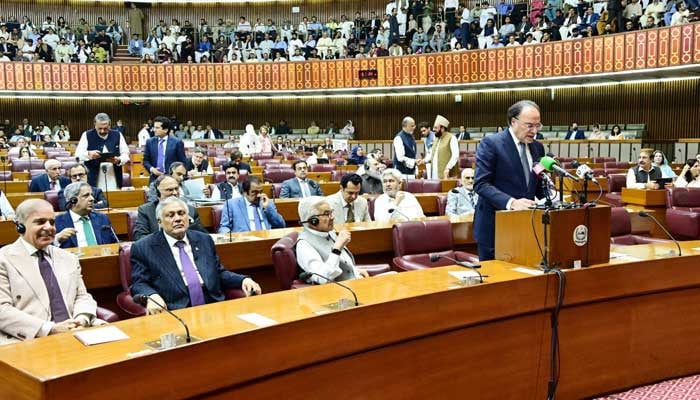
ISLAMABAD: The federal government on Friday laid out an Rs18,771 billion budget for the fiscal year 2026-27, charting a cautious economic course as it grapples with an energy crisis exacerbated by escalating tensions in the Middle East. Finance Minister Muhammad Aurangzeb presented the spending plan in a raucous National Assembly session, framing it as a testament to the country’s rising geopolitical stature.
“This budget is being presented at a time when Pakistan has achieved the status in the eyes of its people and the world as a country whose voice is listened to, and whose friendship is desired,” Aurangzeb declared, linking the nation’s fiscal strategy to a perceived post-conflict confidence. He argued that Pakistan’s role in brokering a ceasefire between Iran and the United States, coupled with what he termed a “humiliating defeat” inflicted on India during last year’s war, had compelled global recognition of its defensive strength.
Debt Servicing Dominates Spending
A breakdown of the colossal outlay reveals the tight fiscal space the government is operating in. The single largest expenditure is a staggering Rs8.054 trillion earmarked for mark-up payments on national debt. Defence allocations follow at Rs3 trillion, while the federal development programme has been set at Rs1 trillion. The finance minister reported that the tax-to-GDP ratio had climbed from 8.5% to 10.3% over years, a sign of improved revenue collection by the Federal Board of Revenue.
Aurangzeb projected an economic growth rate of 4% for the coming year, with average inflation expected to hover around 8.2%. He acknowledged that inflation had ticked upward in recent months “primarily due to the tension in the Middle East,” expressing hope that it would recede once “the war clouds clear.” The current year’s average inflation is estimated at approximately 7%, a slight improvement from an earlier 7.5% forecast. He also highlighted a dramatic fiscal consolidation, with the deficit shrinking from 7.8% of GDP in June 2023 to a projected 4% by the end of the current financial year, and a shift from a primary deficit to a surplus of 1.6%.
Tax Relief and Abolished Super Tax
In a move aimed at salaried workers, the government proposed reducing income tax rates across four slabs. Rates will drop from 23% to 20% those earning between Rs2.2 million and Rs3.2 million, and from 30% to 25% for the Rs3.2 million to Rs4.1 million bracket. Higher earners also see cuts, with the top slab for salaried individuals falling from 35% to 32%.
In a significant concession to businesses, the finance minister announced the complete abolition of the super tax, which had ranged from 1% to 7.5% on business income between Rs150 million and Rs500 million. For income exceeding Rs500 million, the super tax rate will be cut from 10% to 8%. However, existing surcharges on, oil and gas exploration firms, and fertiliser companies will remain unchanged.
Development, Health, and Education Focus
The national development programme totals Rs3,675 billion, with Rs1,000 billion for the federal Public Sector Development Programme (PSDP). Aurangzeb noted that over 60% of the federal PSDP is concentrated on transport, communication, water, and energy, aligning with the ‘Udaan Pakistan’ initiative. A specific allocation of Rs54.6 billion targets sustainable urban development, aiming to construct 150,000 affordable, climate-resistant homes and prepare digital master plans for ten major cities.
On the social front, Rs25.1 billion has been allocated for health projects, focusing on expanding tertiary care, cancer treatment, and modernizing regulatory infrastructure. The higher education sector will receive Rs46 billion, a notable jump from last year’s Rs34.9 billion, to fund scholarships, research capacity, and AI-based education systems. An additional Rs3.6 billion will go toward science and technology.
Energy Reforms and Privatisation Push
Despite the Middle East crisis, the finance minister claimed major successes in energy sector reforms. He reported savings of over Rs143 billion against the allocated power subsidy for FY2025-26 and achieving net-zero accumulation of circular debt in the electricity sector this year. A direct subsidy mechanism for verified consumers is slated for launch in January. To bolster energy security, the government renegotiated long-term LNG agreements, reducing 35 cargoes for 2026 to save an estimated $1.2 billion in foreign exchange, while also adding approximately 100mmcfd of local gas production.
Aurangzeb celebrated the completion of Pakistan International Airlines’ privatisation, handed over for Rs185 billion in a live-televised auction last December. This milestone, he said, is part of a broader five-year plan toise state-owned enterprises including power distribution companies, generation companies, banks, and airports. He also noted a surge in corporate activity, with 11 IPOs launched this year—a two-decade high—and 39,000 new companies registered.
Debt Management Strategy
The government’s debt management strategy has yielded a 68.5% reduction in new national debt this year, according to the minister. By repaying expensive loans early and replacing them with lower-cost borrowing, the debt burden has been slashed by Rs4.9 trillion over two years. The average maturity of domestic debt has been extended from 2.8 years to 3.8 years, mitigating refinancing risk. The government is also pioneering direct investment in bonds via digital wallets to further diversify its debt portfolio.