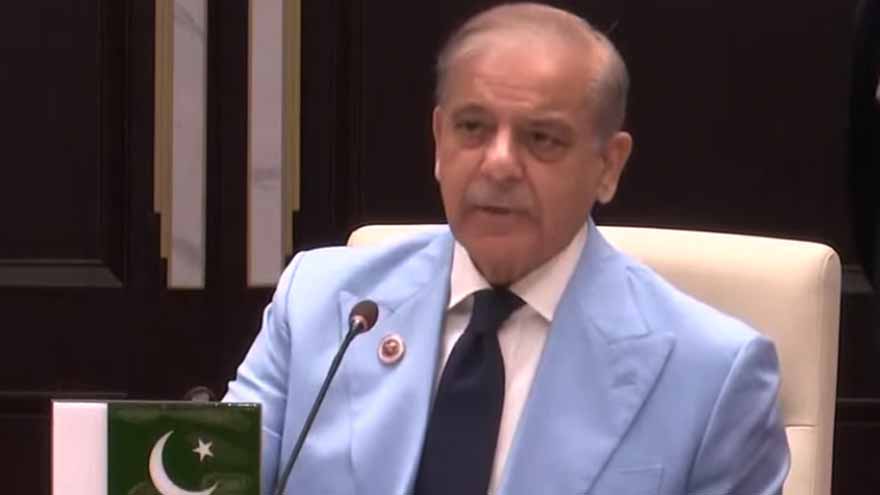
Prime Minister Shehbaz Sharif declared on Tuesday that Pakistan remains committed to lasting regional peace and firmly rejected the use of water for political purposes or as a tool of pressure, during his address at the Shanghai Cooperation Organisation (SCO) Council of Heads of State meeting in Bishkek.
Speaking at what he described as a “historic” gathering, the prime minister said it was an honour to participate in the summit. He thanked Kyrgyz President Sadyr Nurgozhoevich Japarov for the hospitality and congratulated Kyrgyzstan on completing its SCO chairmanship successfully.
Pakistan’s Role in Regional Stability
PM Shehbaz positioned Pakistan as an active and responsible SCO member, warning that the international landscape faces growing geopolitical tensions. He highlighted Islamabad’s diplomatic efforts, including the signing of the Islamabad Memorandum of Understanding, which he called an important step towards reducing regional tensions.
The prime minister identified terrorism as one of the most serious threats facing the region. He noted that more than 90,000 Pakistanis have lost their lives in the fight against militancy, with economic losses exceeding $150 billion.
“Afghan territory must not be allowed to be used by terrorists against Pakistan,” he stressed, while expressing Pakistan’s desire for a peaceful, stable and prosperous Afghanistan.
Water Security and Regional Connectivity
PM Shehbaz raised the issue of water as vital to the region’s survival and the future of coming generations. He called for full implementation of international agreements in both letter and spirit, stating clearly that using water for political purposes is unacceptable.
He described regional connectivity as “no longer a choice but a strategic necessity,” citing the China-Pakistan Economic Corridor (CPEC) as an important link connecting regional economies with the Arabian Sea. Pakistan, he said, remains committed to expanding regional rail, road and energy projects.
SCO Development and Future Chairmanship
With more than three billion people living across SCO member states, the prime minister highlighted enormous potential for trade, investment and economic cooperation. He called for implementation of the SCO Development Strategy 2035 and proposed the establishment of an SCO development bank.
As Pakistan prepares to take over the SCO Council of Heads of State chairmanship for 2026-27, PM Shehbaz said Islamabad would prioritise energy, information technology, health, culture and sports. He also announced plans to propose an artificial intelligence infrastructure and governance framework within the SCO.
Humanitarian Concerns and Global Issues
The prime minister expressed deep concern over the humanitarian situation in Gaza and the West Bank, calling the crisis a source of unimaginable suffering. He urged the international community to respect the Palestinian people’s right to self-determination.
He further stated that South Asia cannot achieve its full potential without sustainable peace, emphasising that stronger cooperation, connectivity and collective security within the SCO could contribute to a more peaceful and prosperous region.
Diplomatic Engagements on Summit Sidelines
On the sidelines of the two-day summit, Deputy Prime Minister and Foreign Minister Ishaq Dar held separate meetings with Iranian Foreign Minister Abbas Araghchi, Chinese Foreign Minister Wang Yi and Belarusian Foreign Minister Maxim Ryzhenkov.
Dar emphasised the importance of dialogue and diplomacy with Araghchi, while his meeting with Wang Yi reaffirmed the Pakistan-China All-Weather Strategic Cooperative Partnership. Discussions with the Belarusian foreign minister focused on bilateral relations and regional developments.
Pakistan is set to assume the SCO chairmanship for 2026-27, with Islamabad scheduled to host the next summit in 2027. The current summit brought together leaders from China, Russia, Iran, India, Türkiye and other member states.