Seven days after the attack, time has stood still for Kadiatou Doukara. The nurse has remained in the same state of shock since the shooting, kneeling on the very ground where she gave first aid to Pengo Bossio Wangi, who was struck by several bullets.
She arrived just after the gunfire. “This is a path I take every day, several times a day. Every time I pass, I relive the scene. Those were three minutes that felt endless. I massage, I massage, I massage… But you can’t give up. The heart has to keep beating, so you don’t let go,” she recalled.
She described feeling “powerless, completely powerless, because I was all alone and there was no equipment. There was nothing.” Her thoughts turn to a life cut short “for nothing, without having asked for anything, because he is Black…”
Born and raised in Trappes, west of Paris, Doukara now denounces political rhetoric she says fuels violence. “I think far-right speeches, such as ‘Trappes is the town full of jihadists and people on the S-file watchlist,’ are the kind of rhetoric that drove Kévin T. to hatred. The people of Trappes, the French majority, we all have the same ID card as him,” she said.
“Children who are afraid from a very young age”
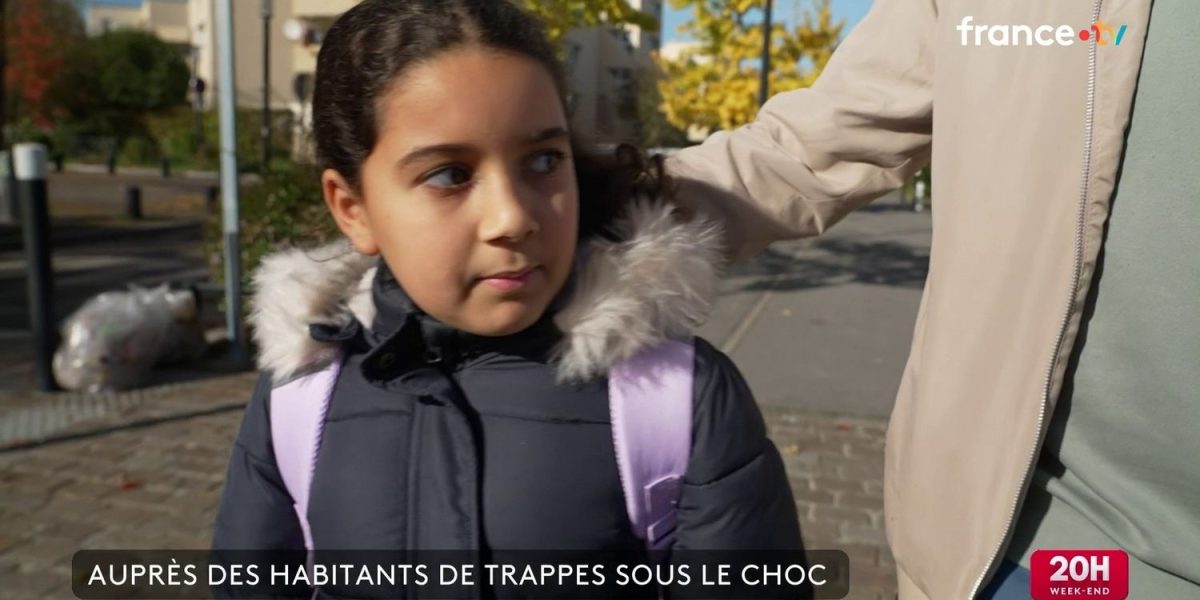
Since the racist attack, dread has spread across the town. Ginane, a young girl, no longer dares to go to her activities alone as she once did. She now asks her father to accompany her.
“They kill Black people, Muslims, everyone who isn’t the same religion as them and the same color. So I’m afraid I’m dead, because I’m Muslim,” she confided.
Her father added: “It hurts me deeply. Every time, I tell her that you have to know you are French. How can we build a society with children who are afraid from a very young age?”
At the time of the attack, Ginane and her brother were playing outside their home. A neighbor told them to get inside urgently and take shelter. “I try to forget it, but every time it comes back. Sometimes it keeps me from sleeping,” the girl explained.
“Diversity is wealth. It is also what makes our country rich. Before going to sleep, she asks me: ‘How did we get here?’” her father said.
Out of fear, a woman who has lived in Trappes for 25 years did not want to show her face. It was a rare outing for her in a week, to a neighborhood association. “People who live all alone… We are even afraid to open our windows. We are afraid to go out,” she said. She has not left her home for a week: “You never know. They shoot at people, outside like that, and they fall.”
“A town where we are all together”
At the market, usually the beating heart of the town, the atmosphere is no longer the same. Djamal Merasli, a retiree, has noticed. “It’s sad, all the same. You can see that the people of Trappes are looking everywhere, to the right, to the left. Before, we would chat for a good half hour. But now, people don’t even talk for two or three minutes,” he lamented.
Yacine Rezig, a shopkeeper, refuses to let the attack set communities against one another. “I am in love with France, I am in love with what this country has been able to give us. Things need to calm down, that is the most important thing,” he said.
“Chez Yolande,” a solidarity grocery store, reflects this cosmopolitan town uniting against racism. Sylvie Verstraeten, a volunteer, is still in shock. “It’s emotional, because this is an ideology I have always fought. I live in a town where we are all together. Beyond skin color, beyond religion or non-religion, we live in harmony. That is what living in harmony means,” she said, visibly moved.
A fragile harmony. Many residents of Trappes fear that the presidential campaign will exacerbate tensions.